
Best eSIM for Europe Travel: One Plan for Multiple Countries
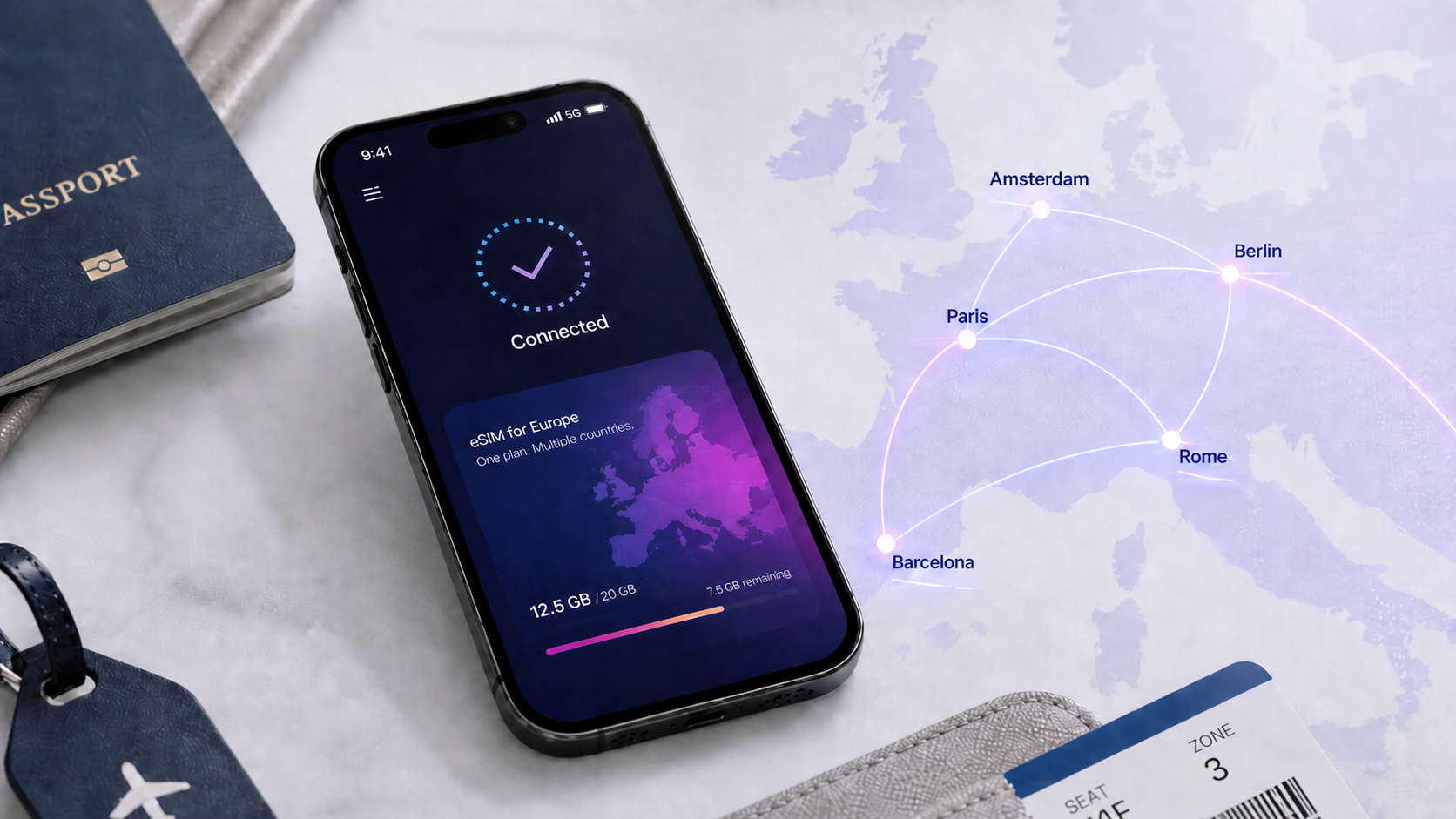
Best eSIM for Europe travel with one regional data plan for multiple countries using duasim
Best eSIM for Europe Travel: One Plan for Multiple Countries
Planning a Europe trip often means crossing borders quickly. You might land in Paris, take a train to Amsterdam, fly to Rome, and finish your trip in Barcelona. The travel is easy. Staying connected can be less simple if your mobile plan does not cover every country on your route.
That is why many travelers now look for the best eSIM for Europe travel before they fly. Instead of buying a local SIM card in every country or worrying about data roaming, a Europe eSIM can give you mobile data across multiple destinations with one digital plan.
With a travel eSIM Europe plan from duasim, you can choose a regional data plan online, install it on a compatible phone, and use mobile data abroad without changing your physical SIM card. duasim’s Europe regional page lists multi-country coverage, instant activation, and data-only plan options ranging from smaller travel data packages to larger plans for heavier use; travelers should always check the live plan page because coverage and plan details can vary by package.
Why Europe Travelers Need a Multi-Country eSIM
Europe is one of the easiest regions in the world for multi-country travel. Short flights, trains, buses, and open-border travel across much of the continent make it common to visit several countries in one trip.
But mobile connectivity can become confusing when your itinerary includes several destinations. A tourist visiting Germany, France, Italy, Spain, and the Netherlands may not want to:
- Buy a new local SIM card in every country
- Search for mobile shops after landing
- Depend on hotel Wi-Fi or public Wi-Fi
- Pay unpredictable roaming charges
- Carry a pocket Wi-Fi device
- Remove their main SIM card
A regional eSIM is designed to solve this problem. Instead of buying separate country plans, you can use one Europe data plan that works across supported destinations. This is especially useful for travelers moving between countries every few days.
What Makes the Best eSIM for Europe Travel?
The best eSIM for Europe travel is not always the one with the biggest data allowance or the lowest advertised price. The right choice depends on your route, trip length, phone, and data habits.
When choosing a Europe eSIM, look for these factors.
1. Multi-country coverage
Your eSIM should cover the countries you are actually visiting. If your trip includes both EU and non-EU destinations, check the coverage list carefully. For example, Switzerland, the United Kingdom, Türkiye, Albania, Serbia, Montenegro, and North Macedonia may not always be included in every Europe roaming or eSIM package.
duasim’s Europe regional eSIM page lists countries such as France, Germany, Italy, Spain, the Netherlands, Greece, Norway, Switzerland, Türkiye, the United Kingdom, Albania, Serbia, and more, with a note that individual packages may cover different subsets.
2. The right amount of data
A good Europe data plan should match how you use your phone. You probably need less data if you only use maps, messaging, email, and light browsing. You may need more if you stream video, use hotspot, work remotely, upload content, or rely on video calls.
As a simple guide:
- 1GB–3GB: Short city break, maps, messaging, basic browsing
- 5GB–10GB: One to two weeks of regular travel use
- 20GB+: Longer trips, content creators, digital nomads, remote workers
- 50GB or more: Heavy users who rely on mobile data daily
To save data, download offline maps, use hotel Wi-Fi for large uploads, and turn off automatic cloud backups while traveling.
3. Easy setup before departure
A major benefit of an eSIM is that you can prepare before you travel. Apple says eSIM removes the need to carry or swap physical SIM cards, and compatible iPhones can use a home phone number and travel eSIM together. (Apple Support)
Before leaving, check that your phone supports eSIM and is unlocked. Then install your eSIM while you still have stable Wi-Fi. You can usually activate the plan when you arrive, depending on the plan rules.
duasim also offers a compatibility checker that lists supported device brands and explains how to check for eSIM support on iPhone and Android.
4. Predictable prepaid pricing
A prepaid Europe eSIM helps travelers manage costs because you choose your data plan before using it. That can be easier to control than open-ended roaming.
This matters especially for travelers coming from outside the EU or visiting European destinations that are not included in their home carrier’s roaming package. Google’s Pixel help page specifically recommends using a prepaid eSIM from international carriers to avoid roaming charges while traveling. (Google Hjelp)
5. Ability to keep your main number active
Many travelers worry they will lose access to calls, SMS, WhatsApp, banking codes, or iMessage if they use an eSIM. In many cases, you can keep your main SIM active for your regular number and use your travel eSIM for data.
This is useful because you can:
- Keep your normal phone number active
- Use apps like WhatsApp, iMessage, FaceTime, Messenger, and email over data
- Avoid swapping tiny SIM cards
- Keep your main SIM safe in your phone
Always check your phone settings before travel so your main SIM is not using expensive roaming data in the background.
Europe eSIM vs Roaming vs Local SIM Card
When searching for the best eSIM for Europe travel, most people are comparing three options: roaming, local SIM cards, and regional eSIM plans.
Europe eSIM
A Europe eSIM is usually best for travelers who want simple mobile data across multiple countries. You can buy it online, install it digitally, and avoid visiting a mobile store after arrival.
Best for:
- Multi-country trips
- Tourists who want quick setup
- Business travelers
- Digital nomads
- People who want to keep their main number active
- Travelers looking for a local SIM card alternative
Data roaming
Roaming may be convenient if your home provider includes Europe in your plan. Within the EU, “roam like at home” rules mean travelers from one EU country to another can use calls, texts, and data at domestic rates, subject to fair-use rules. (European Union)
However, this does not automatically help every traveler. If you are visiting Europe from outside the EU, or if your route includes countries outside your carrier’s included roaming zone, you may still face daily fees, data caps, or higher charges.
Best for:
- Travelers whose home plan already includes Europe
- Short trips with low data usage
- People who do not want to install another plan
Local SIM card
A local SIM card can work well if you are staying in one country for a long time and need calls or a local number. But for a multi-country trip, buying separate SIM cards can become inconvenient.
Best for:
- Long stays in one country
- Travelers who need a local phone number
- People with phones that do not support eSIM
For most tourists visiting several countries, a regional eSIM plan is usually the easiest option.
How to Choose the Right Europe Data Plan
The best plan depends on your travel style. Here are practical examples.
Weekend city break
If you are visiting one or two cities for a few days, a smaller eSIM data plan may be enough. You will mainly use maps, restaurant searches, ride-hailing apps, train tickets, and messaging.
Look for:
- Short validity
- 1GB to 3GB of data
- Simple setup
- Coverage for your exact destination
Two-week Europe vacation
For a trip across several countries, choose a regional eSIM with enough data for navigation, bookings, translation, social media, and regular browsing.
Look for:
- Multi-country coverage
- 5GB to 10GB or more
- Validity that covers the full trip
- Easy top-up or plan management options
Business travel
Business travelers need reliable mobile data Europe access for email, video calls, maps, ride-hailing, and work apps. Running out of data before a meeting can be stressful.
Look for:
- Larger data allowance
- Coverage across all meeting destinations
- Hotspot support if needed
- Easy management in the duasim app
Digital nomads and remote workers
Digital nomads often need more data than tourists. If you work from cafés, coworking spaces, airports, trains, or short-term rentals, choose a larger plan and use Wi-Fi for heavy uploads when possible.
Look for:
- 20GB or more
- Longer validity
- Regional eSIM plans
- Strong destination coverage
- A backup plan for important work calls
How to Set Up a Europe eSIM Before You Travel
The exact steps can vary by phone, but the process is usually simple.
- Check phone compatibility
Make sure your phone supports eSIM and is unlocked. - Choose your destination or region
For a multi-country Europe trip, select a regional Europe eSIM instead of separate country plans. - Buy your eSIM online
Choose a prepaid Europe eSIM based on trip length and data needs. - Install the eSIM
Follow the QR code or app instructions. Do this with a stable Wi-Fi connection. - Label your SIMs
Name your home SIM “Main” and your travel eSIM “Europe Data” so you can manage them easily. - Turn on the eSIM when you arrive
Set your Europe eSIM as the mobile data line. - Turn off roaming on your main SIM
This helps avoid accidental data roaming charges from your home carrier. - Test your connection
Open maps or a web page once you arrive. Restart your phone if the network takes a few minutes to connect.
With the duasim app, travelers can view and manage eSIMs in one place and activate directly from the app.
Practical Connectivity Tips for Europe
A good Europe eSIM helps, but a few habits can make your mobile data last longer.
- Download Google Maps or Apple Maps offline before travel.
- Save hotel addresses, train tickets, and boarding passes offline.
- Turn off automatic app updates on mobile data.
- Use Wi-Fi for large photo and video backups.
- Check whether your plan supports hotspot before relying on it.
- Keep your eSIM QR code or installation details accessible.
- Make sure your travel eSIM is selected for mobile data.
- Keep your main number active only for calls and texts if needed.
These small steps can help you stay connected abroad with duasim while avoiding unnecessary data use.
Why Consider a duasim Europe eSIM?
duasim is built for travelers who want simple digital connectivity without a physical SIM card. The duasim store lets users browse eSIM plans for over 200 countries and regions, including multi-country regional eSIM packages.
For Europe travel, duasim’s regional eSIM plans are useful because they are designed for trips across multiple destinations. Instead of buying one plan for France, another for Italy, and another for Spain, you can choose a Europe plan that fits your route and data needs.
duasim may be a good fit if you want:
- A travel eSIM for multi-country Europe trips
- Regional eSIM plans instead of separate country plans
- Global coverage options for future trips
- A simple way to buy mobile data before departure
- An app to help manage your eSIMs
- A digital setup with no physical SIM card
Before buying, always check the live coverage list, data amount, validity, and device compatibility.
FAQ: Best eSIM for Europe Travel
What is the best eSIM for Europe travel?
The best eSIM for Europe travel is usually a regional eSIM that covers all the countries on your itinerary, gives you enough data for your trip length, works with your phone, and is easy to activate before or when you arrive.
Does one Europe eSIM work in multiple countries?
Yes, many Europe eSIM plans are designed for multi-country travel. However, coverage varies by provider and plan, so check the supported country list before buying.
Is a Europe eSIM better than roaming?
A Europe eSIM can be better than roaming if your home carrier charges daily fees, limits data, or does not include the countries you are visiting. Roaming may still be fine if your existing plan already includes your destinations at no extra cost.
Can tourists use an eSIM in Europe?
Yes. An eSIM for tourists Europe plan is one of the easiest ways to get mobile data without buying a local SIM card. You need an unlocked, eSIM-compatible phone.
How much data do I need for Europe travel?
Light travelers may be fine with 1GB to 3GB for a short trip. Most regular travelers should consider 5GB to 10GB for one to two weeks. Remote workers, streamers, and heavy users may need 20GB or more.
Can I keep my normal phone number while using a Europe eSIM?
In many cases, yes. Many modern phones let you keep your main SIM active for calls and texts while using your eSIM for mobile data. Check your phone settings and carrier rules before travel.
Should I install my eSIM before flying?
Yes, it is usually best to install your eSIM before departure while you have reliable Wi-Fi. Then you can turn it on when you arrive in Europe, depending on your plan’s activation rules.
Conclusion: Choose One Europe eSIM and Travel With Less Stress
The best eSIM for Europe travel is the one that fits your route, data needs, trip length, and phone. For most multi-country travelers, a regional Europe eSIM is simpler than roaming, easier than buying local SIM cards, and more practical than relying on public Wi-Fi.
Before your trip, check your phone compatibility, choose a Europe data plan that covers your destinations, install your eSIM on Wi-Fi, and make sure your travel eSIM is selected for mobile data when you arrive.
To stay connected abroad with duasim, explore the Europe regional eSIM plans on duasim.com and choose the plan that matches your next European trip.