
eSIM vs Roaming: Which Is Cheaper for International Travel?
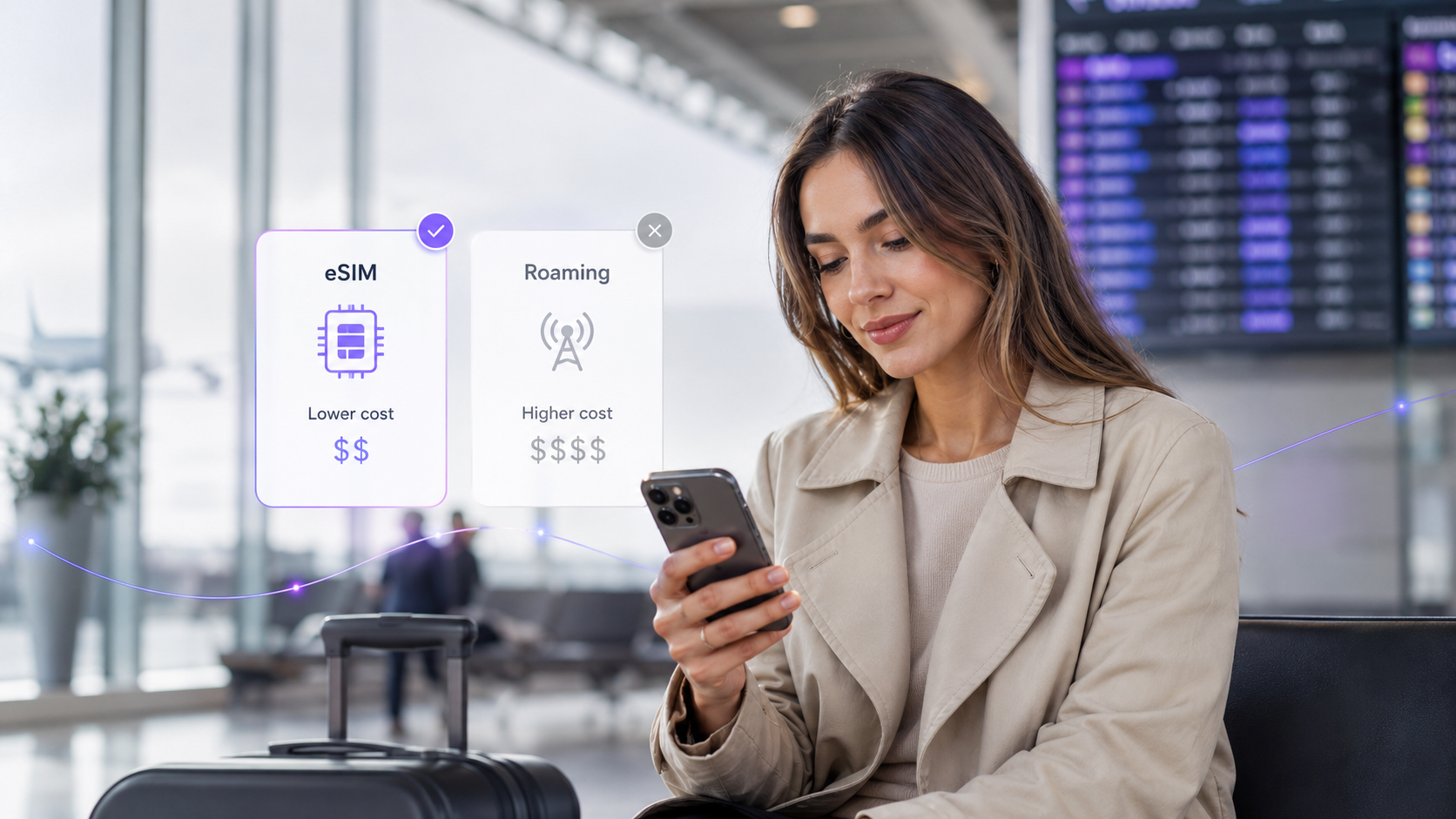
Traveler comparing eSIM and roaming costs for international travel on a smartphone
eSIM vs Roaming: Which Is Cheaper for International Travel?
When you travel abroad, your phone can quickly become one of your most important tools. You use it for maps, hotel bookings, ride-hailing, translation, boarding passes, messaging, email, and sharing your trip. But staying connected can also become expensive if you do not understand the difference between eSIM vs roaming.
Many travelers ask the same question before a trip: should I use my home carrier’s roaming plan, or should I buy a travel eSIM? The answer depends on your destination, trip length, data needs, and your mobile provider’s roaming terms.
In many cases, a prepaid travel eSIM gives you more control over your mobile data abroad because you buy a set data plan before or during your trip. Roaming can be convenient, but it may come with daily fees, fair-use limits, or unexpected charges depending on your provider and destination.
This guide explains how eSIM and roaming compare, when each option makes sense, and how duasim can help travelers stay connected abroad with simple travel data options.
eSIM vs Roaming: The Quick Answer
For many international travelers, a travel eSIM is often the better choice when they want predictable prepaid mobile data, easy setup, and more control over costs. Google’s Pixel support guidance also recommends using a prepaid eSIM from international carriers to avoid roaming charges while traveling. (Google Help)
Roaming can still be useful if your existing phone plan already includes your destination at no extra cost, or if you need your regular phone number for calls and SMS while abroad. Apple recommends checking whether your carrier includes international roaming or offers travel passes before you leave. (Apple Support)
A simple way to think about it:
Option | Usually best for |
|---|---|
Travel eSIM | Prepaid data, cost control, tourists, multi-country trips, avoiding high roaming charges |
Roaming | Short trips, included roaming plans, travelers who need calls/SMS from their main number |
Local SIM card | Long stays in one country, users who need a local phone number |
Public Wi-Fi only | Very light use, but not ideal for maps, transport, security, or emergencies |
What Is Data Roaming?
Data roaming means your phone connects to a mobile network outside your home carrier’s normal network. Your home carrier then bills you based on its roaming agreement and your plan terms.
Roaming can feel simple because you do not need to install anything new. You land, turn on your phone, and your existing SIM or eSIM connects to a partner network. But the cost depends on your carrier.
Roaming may include:
- A daily international travel pass
- Pay-per-megabyte charges
- A limited data allowance
- Slower speeds after a certain limit
- Extra fees outside included destinations
- Fair-use restrictions
In the European Union, “roam like at home” rules allow EU residents traveling within the EU to use calls, texts, and mobile data at domestic rates, subject to fair-use rules. (Digital Strategy) But this does not automatically apply to every traveler. If you are visiting Europe from outside the EU, traveling outside your carrier’s included zone, or visiting non-EU destinations, roaming charges can still apply.
What Is a Travel eSIM?
An eSIM is a digital SIM built into many modern phones. Instead of inserting a physical SIM card, you install a mobile data plan digitally, often through a QR code or app.
A travel eSIM is designed for international travel. You choose a destination, region, or global plan, install it on your compatible phone, and use it for mobile data abroad.
This is useful because you can:
- Buy an eSIM online before you travel
- Avoid changing physical SIM cards
- Keep your main number active on your home SIM
- Use prepaid travel data
- Choose country, regional, or global coverage
- Avoid relying only on public Wi-Fi
duasim focuses on this travel use case. The duasim homepage describes eSIM connectivity in 200+ countries, no physical SIM card, and activation within seconds, while the store lets travelers browse eSIM plans for more than 200 countries and regions. (duasim.com)
Which Is Cheaper: eSIM or Roaming?
The cheaper option depends on your carrier, destination, and how much data you use.
When roaming may be cheaper
Roaming may be cheaper if your mobile plan already includes your destination at no extra cost. This is common for some regional plans, especially inside certain roaming zones.
Roaming may also work well if:
- You are taking a very short trip
- You only need small amounts of data
- Your carrier gives you a generous international allowance
- You need your regular number for calls and texts
- Your employer pays for your mobile plan
Before you travel, check your carrier’s roaming page and confirm the exact countries included. Do not assume that “Europe,” “Asia,” or “worldwide” means every destination is covered.
When a travel eSIM may be cheaper
A travel eSIM may be cheaper or more predictable if your home carrier charges daily roaming fees or expensive data rates. Instead of paying open-ended roaming costs, you buy a prepaid eSIM data plan based on your destination and expected usage.
A travel eSIM can be especially useful if:
- Your carrier charges high daily roaming fees
- You are traveling for more than a few days
- You are visiting multiple countries
- You mostly need data, not calls or SMS
- You want to avoid roaming charges
- You want a local SIM card alternative
- You prefer to buy mobile data before departure
The key benefit is control. You know what data package you selected before you start using it.
Cost Is Not the Only Factor
Price matters, but the best choice is not always only about cost. When comparing eSIM vs roaming, also consider convenience, flexibility, and risk of surprise charges.
1. Predictability
A prepaid eSIM data plan can make travel budgeting easier because you choose your data package in advance. Roaming can be simple, but the final cost may depend on daily passes, usage rules, fair-use limits, or accidental background data.
2. Setup
Roaming requires little setup if your carrier already supports your destination. A travel eSIM requires installation, but this is usually straightforward on compatible phones.
Apple explains that travelers can purchase a travel eSIM and that international roaming with an eSIM works like roaming with a physical SIM, depending on the carrier. (Apple Support)
3. Compatibility
Not every phone supports eSIM. Before buying, check that your device is eSIM-compatible and unlocked.
duasim provides a compatibility checker with supported Apple, Samsung, Google, Motorola, Xiaomi, Oppo, Sony, Huawei, Honor, and other devices, plus steps to check eSIM support on iPhone and Android. (duasim)
4. Keeping your main number active
Many travelers want to keep their main number active for banking codes, SMS, WhatsApp, iMessage, or work calls. In many cases, you can keep your home SIM active and use your travel eSIM for data.
This setup can be practical, but you must choose the correct mobile data line and avoid letting your home SIM use roaming data in the background.
5. Multi-country travel
If you are visiting several countries, a regional eSIM or global eSIM may be easier than checking roaming rules for every destination. duasim’s store includes regional options, including multi-country packages where one plan covers multiple destinations. (duasim)
How to Avoid Roaming Charges When Using an eSIM
A travel eSIM helps, but your phone settings matter. If your main SIM is still allowed to use data roaming, you may still receive roaming charges from your home carrier.
Before you travel, follow this checklist:
- Check your phone compatibility
Make sure your device supports eSIM and is unlocked. - Buy your travel eSIM before departure
Choose a country, regional, or global eSIM data plan based on your trip. - Install the eSIM on Wi-Fi
Install it at home, at the airport, or anywhere with a stable connection. - Label your SIMs clearly
For example: “Main Number” and “Travel Data.” - Set your travel eSIM as the mobile data line
This tells your phone to use the eSIM for internet while traveling. - Turn off data roaming on your main SIM
This helps prevent background apps from using your home carrier’s roaming data. - Keep your main SIM active only if needed
You may want it for calls, texts, or verification codes. - Monitor your data usage
Turn off automatic app updates, cloud backups, and video autoplay on mobile data.
This setup helps you avoid roaming charges with duasim while still using reliable mobile data abroad.
eSIM vs Roaming for Different Traveler Types
Tourists
Tourists usually need maps, messaging, restaurant searches, tickets, transport apps, and social media. A travel eSIM is often a practical choice because it provides mobile data abroad without visiting a local store.
Business travelers
Business travelers need dependable access to email, calendar apps, maps, ride-hailing, and video calls. Roaming may be convenient if paid by an employer, but a prepaid eSIM can offer better cost control for self-employed travelers or small teams.
Digital nomads and remote workers
Digital nomads often travel for longer and use more data. A global eSIM or regional eSIM can be helpful when moving between countries. However, for heavy video calls and uploads, it is still smart to combine mobile data with reliable Wi-Fi.
Families
Families may find roaming expensive if every person activates a daily pass. A travel eSIM can be a flexible option for each compatible phone, especially for teenagers or adults who mainly need data.
Frequent flyers
Frequent flyers may benefit from regional or global eSIM plans because they often move between countries and do not want to manage a new local SIM every time.
When Roaming Is Still a Good Choice
A balanced comparison should be clear: roaming is not always bad.
Roaming may be the better choice if:
- Your plan includes your destination at no extra cost
- You need your regular number for calls and SMS
- Your trip is very short
- Your employer covers international usage
- You do not want to install a separate eSIM
- Your phone does not support eSIM
The important step is checking your carrier’s terms before you travel. Look for daily fees, included countries, data limits, speed restrictions, and fair-use rules.
When a duasim Travel eSIM Makes Sense
A duasim travel eSIM may make sense if you want a prepaid data option before your trip, prefer no physical SIM card, and want to browse plans by destination or region.
duasim is especially relevant for travelers who want:
- Mobile data abroad with clear plan selection
- No physical SIM card swapping
- Country, regional, and global eSIM options
- Flexible eSIM data plans
- The ability to manage eSIMs in the duasim app
- A travel data option for multiple destinations
The duasim app is designed to help users manage plans, view eSIMs in one place, receive data usage alerts, and activate an eSIM directly from the app. (duasim)
Before buying, always confirm your destination, data amount, validity, and phone compatibility.
FAQ: eSIM vs Roaming
What is the difference between eSIM vs roaming?
The difference between eSIM vs roaming is that an eSIM is a digital SIM or data plan you install on your phone, while roaming means using your home carrier’s plan on a foreign network. A travel eSIM is often prepaid, while roaming is billed through your usual mobile provider.
Is eSIM cheaper than roaming?
An eSIM can be cheaper than roaming if your carrier charges daily travel fees or expensive international data rates. Roaming may be cheaper if your existing plan already includes your destination at no extra cost.
Can I avoid roaming charges with an eSIM?
Yes, a prepaid travel eSIM can help you avoid roaming charges, but you must set your eSIM as the mobile data line and turn off data roaming on your main SIM.
Do I need to turn roaming on for my travel eSIM?
Some travel eSIM plans may require data roaming to be enabled on the eSIM line. The key is to avoid enabling roaming data on your main home SIM unless you understand your carrier’s charges.
Can I use my normal phone number with a travel eSIM?
In many cases, yes. Many modern phones allow dual SIM use, meaning your home SIM can remain active for calls or texts while your travel eSIM handles mobile data.
Is an eSIM better than a local SIM card?
An eSIM is usually easier if you want to buy data before travel and avoid visiting a phone shop. A local SIM card may be better for long stays in one country or if you need a local phone number.
Conclusion: Choose the Option That Gives You Control
When comparing eSIM vs roaming, the best choice depends on your trip. Roaming is convenient when it is already included in your mobile plan. But if your carrier charges daily fees, limits data, or does not cover your destination, a prepaid travel eSIM can be a simpler and more predictable way to get internet while traveling.
For many tourists, business travelers, digital nomads, and frequent flyers, a duasim travel eSIM offers a practical way to use mobile data abroad without changing physical SIM cards. You can browse destination and regional plans, check compatibility, install your eSIM, and manage your travel data through duasim.com or the duasim app.
To compare options for your next trip, visit duasim.com or open the duasim app and choose the eSIM plan that fits your destination before you travel.