
Best eSIM for Europe Travel: One Plan for Multiple Countries
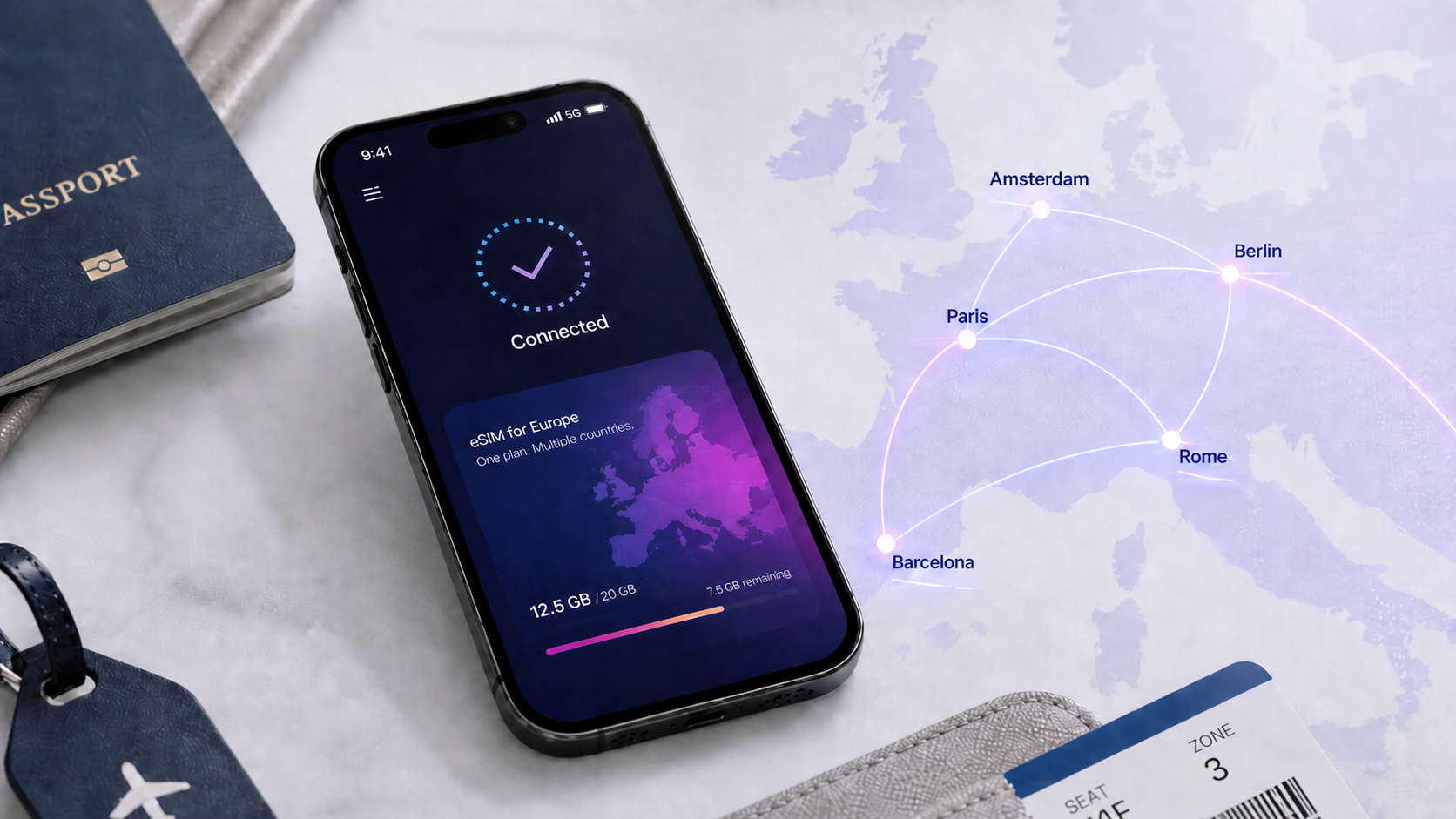
Best eSIM for Europe travel with one regional data plan for multiple countries using duasim
Best eSIM for Europe Travel: One Plan for Multiple Countries
Traveling through Europe often means visiting more than one country in a single trip. You might land in France, take a train to Switzerland, continue to Italy, and finish your journey in Spain. Or you might explore the Balkans, visit several capital cities, take a cruise, or combine business meetings across different European destinations.
For trips like these, staying connected should be simple. A Europe eSIM plan can give you mobile data across multiple European destinations without buying a new physical SIM card in every country or relying on expensive roaming from your home operator.
The best eSIM for Europe travel is usually one that gives you reliable regional coverage, easy digital installation, clear prepaid pricing, and enough data for your route. Instead of changing SIM cards or searching for mobile shops after arrival, you can prepare your data before departure and use your phone when you need it most.
Why a Europe eSIM is useful for multi-country travel
Europe is one of the most common regions for multi-country travel. Short distances, international train routes, low-cost flights, road trips, cruises, and regional tourism make it easy to visit several countries during the same journey.
That also means your mobile data needs can change quickly. One day you may be using maps in Rome, the next day checking train tickets in Vienna, and later ordering transport in Prague.
A Europe eSIM is useful because it can help you stay connected across several countries with one digital data plan. This makes travel easier, especially when you need mobile data for navigation, bookings, communication, payments, translation, and travel updates.
Instead of thinking about where to buy a local SIM card in each destination, you can focus on the trip itself.
What is a Europe eSIM?
A Europe eSIM is a digital SIM plan designed for mobile data use across European destinations. It works through the eSIM technology already built into many newer smartphones.
Unlike a physical SIM card, an eSIM does not need to be inserted into your phone. You install it digitally, usually by scanning a QR code or following the activation instructions from your eSIM provider.
With duasim, you can choose a prepaid Europe eSIM plan before you travel. Once installed, your eSIM can connect to supported mobile networks in the included European countries.
A Europe eSIM is especially useful if you want one travel data solution for several destinations instead of buying separate country-specific SIM cards.
How does a Europe eSIM work?
A Europe eSIM works by adding a prepaid mobile data plan to your phone digitally. After installation, you can select the eSIM as your mobile data line and use it while traveling in supported European destinations.
The typical process is simple:
- Choose a Europe eSIM or regional data plan.
- Select the data amount and validity period that fits your trip.
- Install the eSIM on your compatible phone.
- Turn on the eSIM when you are ready to use mobile data abroad.
- Use mobile data in the included European countries.
If you are new to eSIMs, it can be helpful to first read our guide explaining what a travel eSIM is and how it works. That article explains the basics of eSIM technology, installation, activation, and travel use.
Why choose one Europe eSIM instead of several local SIM cards?
Buying local SIM cards can work well for longer stays in one country. But for multi-country trips, it can become inconvenient.
If you visit several countries, you may need to buy a new SIM card each time, compare local offers, visit mobile stores, deal with language barriers, and replace the SIM already in your phone. Some local SIM cards may also require registration or identification.
A Europe eSIM is often easier because it is digital and can be prepared before your trip.
With one regional Europe eSIM plan, you can:
- avoid buying separate SIM cards in each country
- keep your regular SIM card in your phone
- prepare your mobile data before departure
- connect without visiting a local mobile shop
- use mobile data across supported European destinations
- manage your connection more easily during the trip
For travelers moving between countries, a regional eSIM is usually more practical than repeatedly switching local SIM cards.
Europe eSIM vs roaming
Many travelers use roaming because it feels automatic. Your phone connects abroad using your home mobile plan, and you continue using data as usual. The problem is that roaming can become expensive, especially if your home operator charges high international rates outside your normal roaming zone.
A prepaid Europe eSIM gives you more control. You choose a data plan before using it, so you know what you are buying. This can help reduce the risk of unexpected roaming bills.
A Europe eSIM may be better than roaming if you want:
- prepaid pricing
- more control over mobile data costs
- a data plan made for travel
- easier multi-country coverage
- less dependence on your home operator’s roaming rates
If you are deciding between the two options, read our guide comparing eSIM vs roaming for international travel before choosing how to stay connected.
Who should use a Europe eSIM?
A Europe eSIM can be useful for many types of travelers, including tourists, business travelers, digital nomads, students, families, backpackers, cruise passengers, and people visiting friends or relatives abroad.
It is especially useful if you:
- are visiting more than one European country
- want mobile data as soon as you arrive
- do not want to search for local SIM cards
- want to keep your regular SIM card in your phone
- prefer prepaid travel data
- use maps, messaging, booking apps, and transport apps often
- want a simple way to stay connected during your trip
For short city breaks, a country-specific eSIM may be enough. For longer routes across several countries, a Europe eSIM plan is usually more convenient.
Best use cases for a Europe eSIM
A Europe eSIM is especially helpful when your trip includes several destinations or when you need reliable mobile data throughout the journey.
Common use cases include:
- a train trip through several European cities
- a road trip across multiple countries
- a cruise with stops in different European ports
- a business trip with meetings in several destinations
- a backpacking route through Europe
- a family holiday across two or more countries
- a digital nomad stay across different European hubs
- a Balkans route through Albania, Kosovo, Montenegro, North Macedonia, Serbia, Croatia, or Bosnia and Herzegovina
For regional routes, one plan can be much easier than managing separate SIM cards or relying only on Wi-Fi.
How much data do you need for Europe travel?
The right amount of data depends on your travel style and how often you use your phone.
If you mainly use maps, messages, email, and travel apps, a smaller data plan may be enough. If you use social media often, upload videos, take video calls, work remotely, or share hotspot with other devices, you may need more data.
As a simple guide:
- Light use: maps, messages, email, browsing, and booking apps
- Medium use: social media, photo uploads, travel apps, and occasional video calls
- Heavy use: streaming, remote work, hotspot sharing, frequent uploads, and long video calls
For a deeper explanation, read our guide on how much mobile data you need when traveling abroad. Choosing the right data amount before departure can help you avoid both overpaying and running out of data too early.
Can you use a Europe eSIM with your normal SIM card?
Yes, in many cases you can keep your regular SIM card active while using a Europe eSIM for mobile data. Many newer smartphones support dual SIM functionality, which allows one physical SIM and one eSIM, or multiple eSIM profiles depending on the device.
This can be useful because you can keep your normal number available for calls, SMS, or bank verification messages while using the eSIM for mobile data in Europe.
Before traveling, check your phone settings carefully. You should know which line is used for mobile data, which line is used for calls and messages, and whether data roaming should be enabled for the eSIM line.
Check your phone before buying a Europe eSIM
Before choosing a Europe eSIM, make sure your phone supports eSIM technology. Many newer iPhone, Samsung Galaxy, Google Pixel, and other modern smartphone models support eSIM, but compatibility can vary by device model and region.
You can check if your phone supports eSIM before buying a plan. This is an important step because an eSIM cannot be inserted physically like a traditional SIM card.
Your phone should also be unlocked, updated, and connected to Wi-Fi during installation.
When should you install your Europe eSIM?
It is usually best to install your Europe eSIM before you leave, while you still have a stable Wi-Fi connection. This gives you time to complete the setup and check your phone settings before your trip starts.
A practical approach is:
- Buy your Europe eSIM before departure.
- Install it at home or somewhere with stable Wi-Fi.
- Keep your primary SIM active if you need your normal number.
- Select your eSIM for mobile data when you are ready to use it.
- Enable data roaming for the eSIM line if required by the plan.
If you need help with setup, installation, or activation, you can visit the duasim eSIM FAQ and support page.
Country-specific eSIM or Europe eSIM: which should you choose?
The best choice depends on your route.
If you are only visiting one country, a country-specific eSIM may be enough. For example, if your entire trip is in Italy, Spain, France, Albania, or Greece, a single-destination plan can be a simple option.
If you are visiting several countries, a Europe eSIM or regional eSIM is usually more convenient. It can give you one data solution for the whole trip instead of separate plans for each destination.
Choose a country-specific eSIM if:
- you are staying in one country
- your trip is short and focused on one destination
- you only need data in one place
Choose a Europe eSIM if:
- you are visiting several European countries
- your route may change during the trip
- you want one plan for multiple destinations
- you prefer simpler travel connectivity
You can choose a prepaid Europe eSIM plan for multi-country travel, or browse duasim eSIM plans by destination if your trip is focused on one specific country.
Is a Europe eSIM good for the Balkans?
Yes, a Europe or regional eSIM can be especially useful for Balkan travel, depending on the countries included in the plan. The Balkans are popular for road trips, family visits, summer holidays, nature travel, and multi-country routes.
Travelers often combine countries such as Albania, Kosovo, Montenegro, North Macedonia, Serbia, Croatia, Bosnia and Herzegovina, and Greece in the same trip. In this type of journey, mobile data can be important for navigation, border crossings, accommodation, messaging, and transport.
If you are planning a Balkan route, you may also want to read our guide to the best Balkans eSIM to understand when a regional plan makes sense.
Best Europe eSIM for popular travel routes
The best Europe eSIM depends on your route. A regional plan is especially useful when you travel across several nearby countries or combine city breaks, trains, flights, and road trips.
France, Switzerland, and Italy
A route through France, Switzerland, and Italy is common for train travel, road trips, business travel, and holidays. You may need mobile data for maps, hotel bookings, train tickets, restaurant searches, and messaging across all three countries.
Instead of buying separate local SIM cards, a Europe eSIM plan can help you keep one data setup for the full route.
Spain, Portugal, and France
Many travelers combine Spain, Portugal, and France in one trip, especially for summer holidays, city breaks, road trips, and longer stays. Mobile data can be useful for navigation, transport, bookings, and social apps while moving between cities and regions.
A prepaid Europe eSIM can be a practical option if your trip includes several of these destinations.
Germany, Austria, Czechia, and Hungary
Central Europe is ideal for train trips and city-hopping. Travelers often combine Berlin, Munich, Vienna, Prague, Budapest, and nearby destinations on one route.
A Europe eSIM can help you avoid changing SIM cards or checking roaming rules every time you cross a border.
Albania, Kosovo, Montenegro, and Croatia
The Balkans and Adriatic routes are popular for family visits, road trips, beaches, mountains, and cultural travel. Mobile data is especially useful for maps, border crossings, accommodation, and route planning.
If your route includes several Balkan destinations, a regional Europe plan or a broader option may be more practical than choosing only one country-specific plan.
What to look for in the best eSIM for Europe travel
The best eSIM for Europe travel should match your actual trip. It is not only about choosing the cheapest plan. You should look at coverage, data amount, validity, ease of installation, device compatibility, and whether the plan fits your route.
Before buying, consider:
- which European countries are included
- how much data you need
- how long the plan is valid
- whether your phone supports eSIM
- whether hotspot sharing is supported
- whether the plan fits one country or multiple countries
- how easy installation and activation are
- whether support is available if you need help
For most travelers, the best Europe eSIM is the one that gives enough data for the full trip, works in the destinations they are visiting, and is easy to set up before departure.
Why choose duasim for Europe travel?
duasim is designed for travelers who want a simple and flexible way to stay connected abroad. Instead of dealing with physical SIM cards, uncertain roaming rates, or public Wi-Fi dependence, you can choose a prepaid eSIM plan online and prepare your mobile data before you travel.
With duasim, you can:
- choose a prepaid Europe eSIM plan
- browse eSIM plans for destinations worldwide
- choose country, regional, or global coverage
- install your eSIM digitally
- keep your regular SIM card in your phone
- use mobile data abroad without changing plastic SIM cards
- manage your travel connectivity more easily
For easier access on your phone, you can also download the duasim app and manage your eSIMs while traveling.
Conclusion: one eSIM can make Europe travel easier
The best eSIM for Europe travel is the one that fits your route, your data needs, and your device. If you are visiting several European countries, one regional Europe eSIM can be much easier than buying separate local SIM cards or depending on traditional roaming.
A Europe eSIM gives you a flexible way to stay connected across multiple destinations. You can prepare your data before departure, keep your normal SIM card in your phone, and use mobile data for maps, messages, bookings, transport, payments, and travel apps throughout your trip.
Before you travel, check that your phone supports eSIM, choose a plan that covers your destinations, and install it while you still have a stable Wi-Fi connection. With duasim, you can choose a prepaid Europe eSIM plan and travel through Europe with a simpler way to stay connected.
FAQ: Europe eSIMs
What is the best eSIM for Europe travel?
The best eSIM for Europe travel depends on your route, data needs, trip length, and device compatibility. For multi-country trips, a regional Europe eSIM is often more convenient than buying separate local SIM cards in each country.
Can I use one eSIM in multiple European countries?
Yes, if you choose a regional Europe eSIM that includes the countries you are visiting. Always check the included destinations before buying a plan.
Is a Europe eSIM better than roaming?
A Europe eSIM can be better than roaming if you want prepaid pricing, more control over data costs, and a plan designed for travel. Roaming may be convenient, but it can become expensive depending on your home mobile operator.
Do I need a physical SIM card for a Europe eSIM?
No. A Europe eSIM is digital and does not require a physical SIM card. Your phone must support eSIM technology.
Can I keep my normal phone number while using a Europe eSIM?
In many cases, yes. Many phones allow you to keep your regular SIM active for calls and SMS while using your Europe eSIM for mobile data.
When should I install my Europe eSIM?
It is usually best to install your Europe eSIM before departure while you have stable Wi-Fi. Then you can select it for mobile data when you are ready to use it abroad.
How do I know if my phone supports eSIM?
You can use the duasim eSIM compatibility checker to check whether your phone supports eSIM before buying a plan.
Where can I buy a Europe eSIM?
You can choose a prepaid Europe eSIM plan before your trip and prepare your mobile data before traveling.