
eSIM vs Roaming: Which Is Cheaper for International Travel?
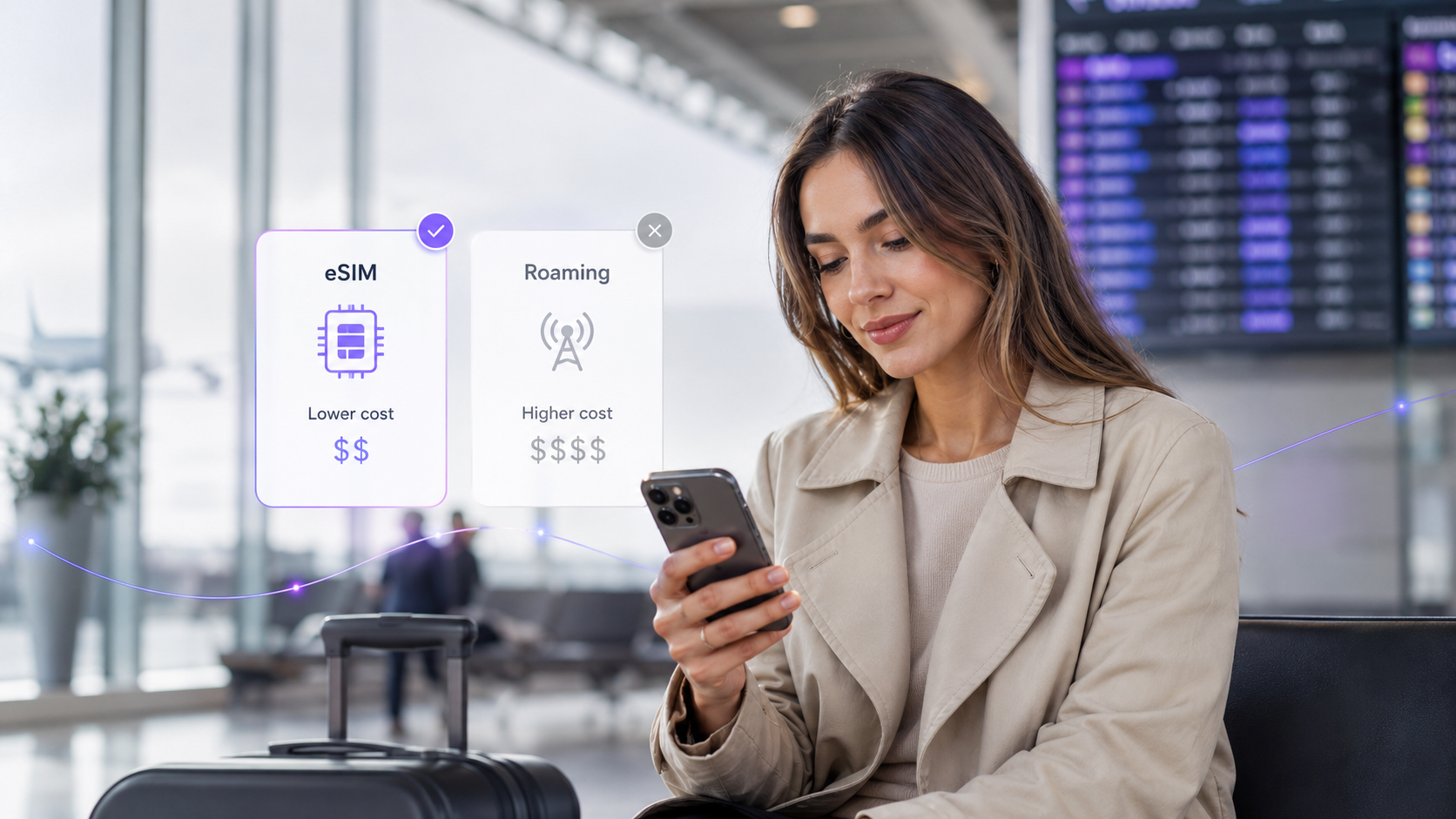
Traveler comparing eSIM and roaming costs for international travel on a smartphone
eSIM vs Roaming: Which Is Cheaper for International Travel?
When you travel abroad, mobile data can quickly become one of those costs you do not think about until it is too late. You use maps, check hotel bookings, message family, order transport, translate signs, browse restaurants, and maybe upload photos from your trip. Without the right setup, all of that data can lead to expensive roaming charges.
That is why many travelers compare eSIM vs roaming before they travel. Both options can help you stay connected abroad, but they work differently. Roaming uses your existing mobile plan when you are outside your home country, while a travel eSIM gives you a separate prepaid data plan for your destination.
In many cases, a travel eSIM can be cheaper, clearer, and more flexible than traditional international roaming. The best choice depends on where you are traveling, how much data you need, and what your home mobile operator charges for roaming.
What is roaming?
Roaming means using your normal mobile plan outside your home network. When you travel abroad, your phone connects to a partner network in the country you are visiting. Your home mobile operator then charges you based on its roaming rules, packages, or pay-as-you-go rates.
Roaming can feel convenient because it often works automatically. You arrive in another country, turn on your phone, and your mobile service may connect without any extra setup.
The problem is cost and control. Depending on your mobile plan and destination, roaming can be expensive. In some countries, even basic mobile data use can lead to high charges if you have not bought a roaming package in advance.
Roaming can also be difficult to understand. Some plans include certain destinations, some only include limited data, and others charge by the megabyte after a small allowance. This makes it harder to know the final cost before your trip ends.
What is an eSIM?
An eSIM is a digital SIM that is built into many newer smartphones. Instead of inserting a physical SIM card, you install an eSIM profile digitally on your device.
A travel eSIM gives you mobile data for a specific country, region, or group of destinations. It is usually prepaid, which means you choose the data amount and validity period before you use it.
With duasim, you can browse prepaid eSIM plans for international travel before your trip and choose a plan based on your destination. This lets you prepare your mobile data in advance instead of depending on your home operator’s roaming prices.
If you are new to eSIM technology, start with our guide explaining what a travel eSIM is and how it works.
eSIM vs roaming: the main difference
The main difference between eSIM and roaming is how you access mobile data abroad.
With roaming, you continue using your normal mobile plan through your home operator. Your phone connects to foreign partner networks, and your home operator decides the roaming price.
With a travel eSIM, you buy a separate prepaid data plan for your destination. You install it digitally and use it for mobile data while traveling.
In simple terms:
- Roaming uses your existing mobile plan abroad.
- A travel eSIM gives you a separate prepaid data plan for your trip.
This difference matters because it affects cost, flexibility, control, and how easy it is to avoid unexpected charges.
Which is cheaper: eSIM or roaming?
In many international travel situations, an eSIM can be cheaper than roaming. This is especially true if your home operator charges high roaming rates outside your home region or if you need more than a small amount of mobile data.
A prepaid eSIM gives you a fixed data allowance for a clear price. You know what you are buying before you travel. Roaming, on the other hand, may depend on your operator’s daily fees, destination zones, data limits, or pay-as-you-go rates.
A travel eSIM is often cheaper when:
- you are traveling outside your normal roaming zone
- your operator charges daily roaming fees
- you need mobile data for several days
- you use maps, messaging, apps, and browsing often
- you want to avoid pay-as-you-go data roaming
- you are visiting several countries and need regional coverage
Roaming may be cheaper or easier if your mobile plan already includes generous data in the country you are visiting. That is why it is always worth checking your home operator’s roaming terms before you travel.
Still, for many travelers, a prepaid eSIM data plan offers a clearer and more predictable way to manage mobile data abroad.
Why roaming can become expensive
Roaming costs can grow quickly because many apps use mobile data in the background. Even if you are not actively browsing, your phone may still sync emails, update apps, refresh social media, download messages, back up photos, or use location services.
Small amounts of background data can add up over several days. If your roaming plan has limited data or high overage costs, you may end up paying more than expected.
Roaming can also become expensive because some operators charge a daily fee as soon as your phone connects abroad. Others charge based on destination zones, where countries outside common travel regions can be much more expensive.
This is why many travelers look for ways to avoid roaming charges while traveling abroad before they leave.
Why eSIM pricing is easier to control
A prepaid travel eSIM is usually easier to control because you choose the plan before using it. You know the destination, data amount, validity period, and price before your trip starts.
This makes budgeting easier. Instead of waiting to see what your roaming bill looks like after your trip, you can choose a data plan that fits your travel needs in advance.
A travel eSIM can also help you separate your travel data from your normal mobile plan. You can keep your regular SIM card in your phone for your main number and use the eSIM for mobile data abroad.
That gives you more control over which SIM line uses data and helps reduce the risk of accidental roaming use.
eSIM vs roaming for short trips
For short trips, the best option depends on your mobile plan and destination.
If you are traveling for one or two days and your home operator offers affordable roaming in that country, roaming may be simple enough. But if your operator charges a daily roaming fee, even a short trip can become expensive.
A travel eSIM can still make sense for short trips if you want prepaid control, mobile data on arrival, or if you are visiting a country where roaming is expensive.
For example, if you are taking a weekend city break, you may only need a small data plan for maps, messages, transport, and bookings. In that case, a small prepaid eSIM plan may be more cost-effective than paying daily roaming charges.
eSIM vs roaming for longer trips
For longer trips, an eSIM is often the better option. The longer you travel, the more important cost control becomes.
Daily roaming fees can add up quickly over one or two weeks. Pay-as-you-go roaming can become even more expensive if you use your phone frequently.
A prepaid eSIM lets you choose a data plan that matches your trip length. You can select enough data for your expected use and avoid relying on your home operator’s roaming rates every day.
If you are traveling for a week or more, especially outside your normal roaming region, it is usually worth comparing roaming costs with a prepaid eSIM before departure.
eSIM vs roaming for multi-country travel
Multi-country travel is one of the strongest reasons to consider a travel eSIM.
If you are visiting several countries, roaming prices may change depending on your operator’s destination zones. Some countries may be included in your plan, while others may cost more.
A regional eSIM can make this easier. Instead of checking roaming rules for every country, you can choose one plan that covers several destinations.
For example, if you are traveling through Europe, a Europe eSIM plan can be more practical than buying separate local SIM cards or depending on different roaming rates in each country.
If your trip includes many countries or different regions, you may also want to consider a global plan. Our guide to global eSIM plans for worldwide travel explains when a worldwide data plan can be useful.
eSIM vs roaming for business travel
For business travelers, the cheapest option is not always only about the price of data. Reliability, control, and convenience also matter.
When you travel for work, you may need mobile data for email, video calls, calendars, messaging, document access, ride-hailing, and navigation. You may also need to stay connected immediately after landing.
Roaming can be convenient if your company phone plan includes international data. But if not, a prepaid eSIM can give you a clearer and more manageable way to access mobile data abroad.
A travel eSIM can be especially useful for business travelers who want to separate travel data from their main number while keeping their regular SIM active for calls or verification messages.
eSIM vs roaming for digital nomads
Digital nomads often need more data and more flexibility than regular holiday travelers. They may work from several countries, move between regions, use hotspot, take calls, and depend on mobile data when Wi-Fi is unreliable.
For digital nomads, roaming can become expensive if used as the main data source. A travel eSIM or regional eSIM can be a better option because it allows more control over data plans and coverage.
If you work while traveling, check the data amount carefully. Remote work, cloud tools, video meetings, and hotspot sharing can use more data than basic travel activities.
Before choosing a plan, it is helpful to estimate how much mobile data you need when traveling abroad.
Can you use eSIM and roaming at the same time?
Yes, in many cases you can keep your normal SIM card active while using a travel eSIM for mobile data. Many modern phones support dual SIM functionality, allowing you to use your regular SIM and an eSIM on the same device.
This setup can be useful because you can keep your normal phone number active for calls, SMS, and verification messages while using your eSIM for mobile data abroad.
The important part is your phone settings. Before traveling, make sure the eSIM is selected for mobile data and your regular SIM is not using expensive data roaming by mistake.
You should also check whether data roaming needs to be enabled for the eSIM line. Some eSIM plans require data roaming to be turned on for the eSIM itself, while your regular SIM data roaming should remain off if you want to avoid roaming charges from your home operator.
How to avoid unexpected roaming charges
Even if you use a travel eSIM, you should adjust your phone settings before traveling.
To reduce the risk of unwanted roaming costs:
- turn off data roaming on your primary SIM
- select your travel eSIM as the mobile data line
- disable automatic data switching if your phone has that option
- check that apps are not using your primary SIM for data
- install your eSIM while connected to stable Wi-Fi
- test your settings before leaving if possible
- monitor data usage during your trip
Before buying an eSIM, you should also check if your phone supports eSIM and make sure your device is unlocked.
What to compare before choosing eSIM or roaming
Before deciding between eSIM and roaming, compare the full travel situation, not just the headline price.
Check:
- your destination or destinations
- your trip length
- your home operator’s roaming rates
- whether roaming is included in your current plan
- how much data you expect to use
- whether you need hotspot sharing
- whether you need to keep your normal number active
- whether your phone supports eSIM
- whether you prefer prepaid pricing or post-trip billing
If roaming is already included in your mobile plan for the countries you are visiting, it may be enough. But if roaming is expensive, limited, or unclear, a prepaid eSIM can often be the better option.
When roaming may still make sense
Roaming is not always the wrong choice. It can make sense when your home mobile plan includes generous international data at no extra cost or when you only need a tiny amount of data for a very short trip.
Roaming may be suitable if:
- your plan already includes your destination
- your operator offers affordable roaming packages
- you do not use much mobile data
- you prefer not to install anything new
- your phone does not support eSIM
The key is to check the details before you travel. Roaming is convenient, but convenience can become expensive if the pricing is unclear.
When a travel eSIM is usually the better choice
A travel eSIM is usually the better choice when you want cost control, prepaid pricing, and a dedicated data plan for your trip.
It is especially useful if:
- your destination is expensive for roaming
- you are traveling for several days or weeks
- you need regular mobile data abroad
- you are visiting several countries
- you want to prepare before departure
- you want to keep your normal SIM card in your phone
- you want to avoid unexpected roaming charges
You can browse duasim eSIM plans by destination to compare country, regional, and global options before your trip.
Why choose duasim instead of roaming?
duasim is built for travelers who want a simple way to stay connected abroad without depending on traditional roaming. Instead of waiting for your phone bill after the trip, you can choose a prepaid eSIM plan before you travel.
With duasim, you can:
- choose prepaid eSIM plans for destinations worldwide
- install your eSIM digitally
- keep your regular SIM card in your phone
- use mobile data abroad without changing physical SIM cards
- choose country, regional, or global coverage
- manage your travel connectivity more easily
For easier access while traveling, you can also download the duasim app and manage your eSIMs from your phone.
Conclusion: eSIM is often cheaper, but compare before you travel
When comparing eSIM vs roaming, the cheaper option depends on your destination, trip length, mobile plan, and data usage. Roaming can be convenient if your operator already includes affordable international data. But for many travelers, roaming can become expensive, especially outside their home region or on longer trips.
A prepaid travel eSIM is often the better choice when you want clear pricing, more control, and mobile data that is designed for international travel. It lets you prepare before departure, avoid physical SIM cards, keep your regular number active, and reduce the risk of unexpected roaming charges.
Before your next trip, compare your operator’s roaming rates with a prepaid eSIM plan for your destination. If you want a simpler way to stay connected abroad, you can choose a prepaid travel eSIM with duasim and travel with more control over your mobile data costs.
FAQ: eSIM vs roaming
Is eSIM cheaper than roaming?
An eSIM is often cheaper than roaming, especially if your mobile operator charges high international roaming rates or daily roaming fees. The exact cost depends on your destination, data needs, and mobile plan.
What is the difference between eSIM and roaming?
Roaming uses your existing mobile plan abroad through your home operator. An eSIM gives you a separate digital data plan for your destination, usually with prepaid pricing.
Can I use an eSIM instead of roaming?
Yes. If your phone supports eSIM, you can use a travel eSIM for mobile data abroad instead of relying on your home operator’s roaming data.
Can I keep my normal number while using an eSIM?
In many cases, yes. Many phones allow you to keep your regular SIM active for calls and SMS while using your travel eSIM for mobile data.
Should I turn off roaming when using an eSIM?
You should usually turn off data roaming on your primary SIM to avoid unwanted charges. Some eSIM plans may require data roaming to be enabled on the eSIM line itself, so check your eSIM instructions carefully.
Is roaming better than eSIM?
Roaming may be better if your mobile plan already includes affordable international data. A travel eSIM is often better if you want prepaid pricing, clearer cost control, and flexible mobile data abroad.
What is the best option for multi-country travel?
For multi-country travel, a regional or global eSIM is often more convenient than roaming or buying several local SIM cards. It can give you one data solution for several destinations.
Where can I buy a travel eSIM?
You can browse duasim prepaid eSIM plans and choose a country, regional, or global plan for your trip.