
How Much Mobile Data Do You Need When Traveling Abroad?
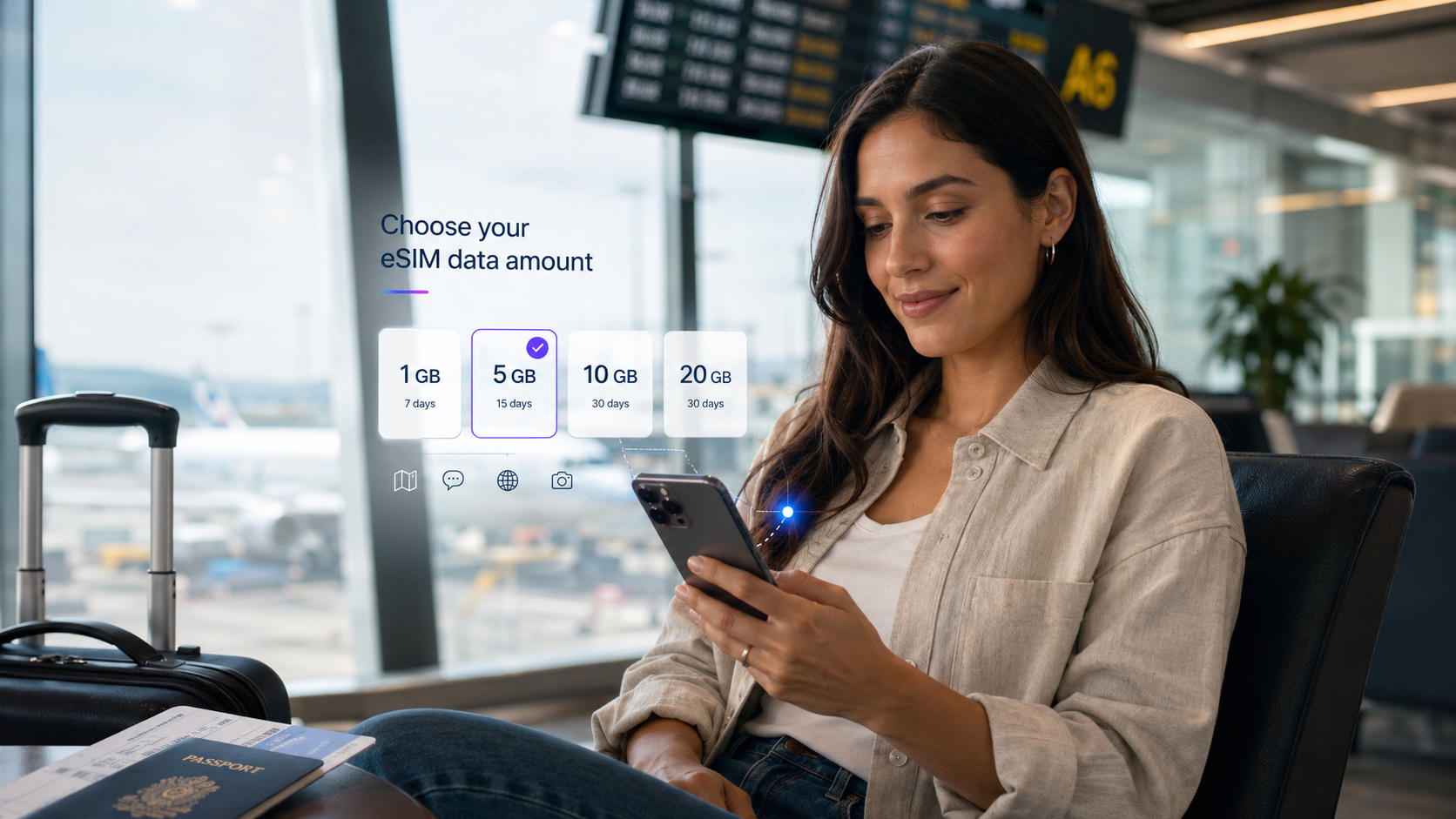
Traveler choosing a mobile data plan on a smartphone before traveling abroad
How Much Mobile Data Do You Need When Traveling Abroad? eSIM Data Plan Guide
Choosing the right amount of mobile data before a trip can be difficult. Some travelers only need maps, messages, and hotel bookings. Others use social media, video calls, hotspot, remote work tools, or streaming while abroad. If you choose too little data, you may run out during the trip. If you choose too much, you may pay for data you never use.
The right eSIM data plan depends on your destination, trip length, travel style, and how you use your phone. For many travelers, a travel eSIM is a simple way to get prepaid mobile data abroad without relying on expensive roaming or searching for a local SIM card after arrival.
This guide explains how much mobile data you may need when traveling abroad, which apps use the most data, and how to choose the right prepaid eSIM data plan for your trip.
Why mobile data matters when traveling abroad
Mobile data is one of the most useful things to have while traveling. It helps you navigate new places, communicate with family or friends, manage bookings, order transport, check opening hours, translate languages, and stay updated during your trip.
When you are abroad, mobile data is often useful for:
- maps and navigation
- messaging apps
- hotel and flight bookings
- ride-hailing and transport apps
- restaurant searches
- translation apps
- online banking and payments
- email and work tools
- social media
- emergency information
Public Wi-Fi can help, but it is not always available when you need it. Airport, hotel, café, and public Wi-Fi can also be slow, unstable, or less secure than mobile data. That is why many travelers prefer to prepare a prepaid data plan before departure.
How much mobile data do most travelers need?
There is no single answer that fits every traveler, but most people can estimate their needs based on how they use their phone.
As a simple guide:
- 1 GB to 3 GB can be enough for short trips with light use.
- 3 GB to 5 GB is suitable for moderate use over several days.
- 5 GB to 10 GB is a good choice for regular app use, social media, maps, and messaging.
- 10 GB to 20 GB may be better for longer trips, frequent social media use, video calls, or hotspot.
- 20 GB or more may be useful for remote work, heavy hotspot use, streaming, or longer stays abroad.
If you mainly use your phone for maps, messages, browsing, and travel apps, you probably do not need a huge data plan. If you often upload videos, stream content, use hotspot, or work remotely, you should choose more data.
Light data use: 1 GB to 3 GB
A smaller data plan can be enough if you use your phone carefully and rely on Wi-Fi for heavier tasks.
A 1 GB to 3 GB eSIM data plan may work for:
- weekend trips
- short city breaks
- checking maps occasionally
- sending messages
- reading emails
- using hotel and flight apps
- browsing restaurants or attractions
- light social media use
This type of plan is best if you avoid video streaming, large uploads, hotspot sharing, and frequent video calls over mobile data.
For example, a traveler spending a few days in one city may only need enough data for navigation, messaging, and travel apps. In that case, a smaller prepaid eSIM plan can be a cost-effective option.
Moderate data use: 3 GB to 10 GB
Many travelers fall into the moderate-use category. This means you use your phone regularly during the day but do not stream or upload large files constantly.
A 3 GB to 10 GB data plan may be suitable for:
- trips lasting several days to one week
- daily maps and navigation
- frequent messaging
- email and browsing
- regular social media use
- checking travel apps
- occasional photo uploads
- occasional voice or video calls
- using transport and booking apps
For many holidays and business trips, this range gives a good balance between price and flexibility. It gives you enough mobile data to use your phone normally without worrying too much about every small action.
Heavy data use: 10 GB to 20 GB or more
You may need a larger eSIM data plan if you use your phone heavily abroad. This is especially true if you work while traveling, use hotspot, upload content, or rely on mobile data instead of Wi-Fi.
A 10 GB to 20 GB or larger plan may be better for:
- long trips
- digital nomad travel
- business travel
- frequent video calls
- hotspot sharing
- cloud tools and file access
- heavy social media use
- uploading photos and videos
- streaming music or video
- using your phone as your main internet connection
If you are traveling for work or staying abroad for more than one week, choosing more data can give you extra flexibility. It can also reduce the stress of constantly checking your remaining data.
How much data do common apps use?
Different apps use very different amounts of data. Text-based apps use very little, while video, streaming, uploads, and hotspot can use much more.
As a general guide:
- messaging apps use very little data for text messages
- email and browsing usually use low to moderate data
- maps use moderate data, especially with live navigation
- social media can use moderate to high data
- music streaming can use moderate data
- video streaming can use a lot of data
- video calls can use a lot of data
- hotspot sharing can use data very quickly
- cloud backups and file uploads can use large amounts of data
The exact usage depends on the app, quality settings, background activity, and how often you use it.
Maps and navigation
Maps are one of the most important travel apps, and they usually do not use extreme amounts of data compared with video or streaming. However, live navigation, route updates, location services, satellite view, and repeated searches can still use data throughout the day.
To reduce data use, download offline maps before your trip while connected to Wi-Fi. This can help you navigate even when your signal is weak and reduce the amount of mobile data used abroad.
Even with offline maps, mobile data is still useful for live traffic, public transport updates, opening hours, ride-hailing apps, and last-minute route changes.
Messaging and calls
Messaging apps usually use very little data when sending text messages. Apps like WhatsApp, Messenger, Telegram, iMessage, and similar services are generally data-friendly for text-based communication.
Voice calls use more data than text messages, and video calls use much more. If your data plan is limited, use video calls on Wi-Fi when possible.
For most travelers, messaging apps are not the main reason data runs out. The bigger risks are video, uploads, hotspot, automatic backups, and social media.
Social media
Social media can use more data than many travelers expect. Apps like Instagram, TikTok, Facebook, Snapchat, and YouTube often load photos, videos, stories, reels, and ads automatically.
If you use social media often while abroad, you may need a larger eSIM data plan. This is especially true if you upload content, watch short videos, or scroll frequently during the day.
To reduce data use, you can:
- turn off autoplay videos
- upload photos and videos on Wi-Fi
- reduce media quality settings
- limit background app refresh
- avoid long sessions on video-heavy apps
Social media is one of the main reasons moderate users become heavy data users while traveling.
Streaming music and video
Streaming can use a lot of mobile data, especially video streaming. Watching films, series, YouTube videos, TikTok, Reels, or live streams over mobile data can quickly use a large part of your plan.
If you want to save data, download music, podcasts, films, or shows before your trip while connected to Wi-Fi. You can also reduce streaming quality in your apps.
For most travelers, it is better to save mobile data for practical travel needs such as navigation, communication, bookings, payments, and transport.
Hotspot sharing
Hotspot can use data very quickly because laptops and tablets often use more data than smartphones. A laptop may automatically sync files, update software, load large websites, download attachments, or back up documents.
If you plan to use hotspot while traveling, choose a larger eSIM data plan and monitor usage carefully.
Hotspot can be helpful for business travel, remote work, or sharing data with another device, but it is one of the fastest ways to use up mobile data abroad.
Cloud backups and automatic updates
Cloud backups and automatic updates can use a lot of data without you noticing. Photo backups, video uploads, app updates, system updates, and file syncing can quickly reduce your data allowance.
Before traveling, set cloud backups and app updates to Wi-Fi only. This applies to services like iCloud, Google Photos, Google Drive, Dropbox, OneDrive, and similar apps.
This is one of the easiest ways to make your eSIM data plan last longer.
How trip length affects your data needs
The longer your trip, the more data you are likely to need. But your daily habits matter more than the number of days alone.
A careful traveler may use very little data over a week by relying on Wi-Fi, downloading maps offline, and avoiding streaming. A heavy user may use several gigabytes in one or two days through video, hotspot, or social media.
As a general starting point:
- Weekend trip: 1 GB to 3 GB may be enough for light use.
- One-week trip: 3 GB to 10 GB is often suitable for moderate use.
- Two-week trip: 10 GB to 20 GB may be better if you use your phone daily.
- Longer stay: 20 GB or more may be useful for heavy use, work, or hotspot.
If you are unsure, it is often safer to choose slightly more data than you think you need, especially if Wi-Fi may be unreliable.
How destination affects data use
Your destination can also affect how much mobile data you need. In cities with reliable hotel Wi-Fi and good public transport, you may use less mobile data. In remote areas, road trips, islands, mountain regions, or places where Wi-Fi is limited, you may rely more on mobile data.
You may need more data if you are:
- driving between destinations
- visiting rural areas
- using maps for long periods
- crossing borders
- staying in accommodation with weak Wi-Fi
- working remotely
- using translation apps often
- traveling with family or sharing hotspot
If your trip includes several countries, a regional or global plan may be more practical than buying separate plans for each destination.
Country, regional, or global eSIM data plan?
The right eSIM data plan depends on your route.
A country-specific eSIM may be enough if you are staying in one destination. For example, if your whole trip is in Spain, Italy, Albania, or Turkey, a single-country plan can be simple and practical.
A regional eSIM may be better if you are visiting several countries in the same area. For example, a Europe eSIM plan can be useful if your trip includes multiple European destinations.
A global eSIM may be better if your trip includes several regions or continents. If you are planning a complex route, read our guide to global eSIM plans for worldwide travel to understand when a worldwide data plan makes sense.
How to choose the right eSIM data plan
Before choosing your eSIM data plan, think about your real travel habits.
Ask yourself:
- How many days will I be abroad?
- Will I visit one country or several countries?
- Will I mainly use maps, messages, and bookings?
- Will I use social media often?
- Will I upload photos or videos?
- Will I stream music or video?
- Will I use hotspot?
- Will I work remotely?
- Will I have reliable Wi-Fi at my hotel or accommodation?
If you only need essential travel data, a smaller prepaid eSIM may be enough. If your phone is part of your work, content creation, or daily entertainment, choose a larger data plan.
You can browse duasim eSIM plans by destination and choose a country, regional, or global plan that fits your trip.
How to make your mobile data last longer abroad
A few simple settings can help your data plan last longer.
Before and during your trip:
- download maps offline
- use Wi-Fi for large downloads
- turn off automatic app updates
- set cloud backups to Wi-Fi only
- reduce video streaming quality
- disable autoplay videos on social media
- limit background app refresh
- avoid unnecessary hotspot sharing
- monitor data usage in your phone settings
- use messaging instead of video calls when data is limited
These steps can make a big difference, especially on shorter trips or smaller data plans.
How to check your phone’s data usage
Most smartphones show mobile data usage in the settings. This can help you understand which apps use the most data.
Before choosing a travel data plan, check your recent data usage at home. Look at how much data you normally use over a week or month, then adjust based on your travel plans.
While traveling, check your usage regularly. If you see that one app is using too much data, you can limit it, use it only on Wi-Fi, or change its settings.
Monitoring your data is especially important if you use hotspot, video calls, streaming apps, or social media often.
Check if your phone supports eSIM before choosing a plan
Before buying an eSIM data plan, make sure your phone supports eSIM. Many newer iPhones, Samsung Galaxy devices, Google Pixel phones, and other modern smartphones support eSIM, but compatibility depends on the exact device model and sometimes the region where it was purchased.
You can check if your phone supports eSIM before choosing a plan.
Your phone should also be unlocked, updated, and connected to Wi-Fi during installation. If your device does not support eSIM, you will not be able to install a digital eSIM plan.
eSIM data plan vs roaming data
When choosing mobile data abroad, it is also worth comparing a prepaid eSIM with roaming from your home operator.
Roaming may be convenient if your plan already includes your destination. But if your operator charges high roaming fees, daily fees, or unclear rates, a prepaid eSIM can give you more control.
A travel eSIM can help you choose a fixed data amount before your trip and reduce the risk of unexpected roaming charges. To compare both options, read our guide to eSIM vs roaming for international travel.
If your goal is to reduce mobile costs abroad, you may also find our guide on how to avoid roaming charges when traveling abroad useful before departure.
Why choose duasim for your eSIM data plan?
duasim is designed for travelers who want a simple way to get mobile data abroad without relying on physical SIM cards or traditional roaming. You can choose a prepaid eSIM plan before your trip and prepare your connection in advance.
With duasim, you can:
- browse prepaid eSIM plans for destinations worldwide
- choose country, regional, or global coverage
- install your eSIM digitally
- keep your regular SIM card in your phone
- use mobile data abroad without changing plastic SIM cards
- manage your travel connectivity more easily
For easier access on your phone, you can also download the duasim app and manage your eSIMs while traveling.
Conclusion: choose your eSIM data plan based on how you travel
The amount of mobile data you need when traveling abroad depends on how long you are away, where you are going, and how you use your phone. A light traveler may only need a few gigabytes for maps, messages, and bookings. A business traveler, digital nomad, or heavy social media user may need a larger data plan with more flexibility.
The best approach is to think about your daily habits before you travel. If you use your phone mainly for essential travel tasks, a smaller prepaid eSIM data plan may be enough. If you use hotspot, video calls, streaming, cloud tools, or frequent uploads, choosing more data can make your trip smoother.
Before your next trip, check that your device supports eSIM, estimate your data needs, and choose a plan that matches your route. With duasim, you can find a prepaid eSIM data plan for your destination and stay connected abroad with more control over your mobile data.
FAQ: Mobile data abroad and eSIM data plans
How much mobile data do I need when traveling abroad?
The amount of mobile data you need depends on your trip length and phone use. Light travelers may only need 1 GB to 3 GB, while regular users may need 5 GB to 10 GB. Heavy users, remote workers, or travelers using hotspot may need 10 GB to 20 GB or more.
Is 1 GB enough for travel?
1 GB can be enough for a short trip if you mainly use maps, messages, email, and light browsing. It may not be enough if you use social media often, stream video, make video calls, or use hotspot.
Is 5 GB enough for a week abroad?
5 GB can be enough for one week abroad with moderate use, especially if you use Wi-Fi for streaming, uploads, and large downloads. Heavy users may need more.
How much data does Google Maps use abroad?
Maps usually use moderate data, but usage depends on route length, live navigation, traffic updates, satellite view, and searches. Downloading offline maps before your trip can help reduce mobile data use.
What uses the most mobile data while traveling?
Video streaming, video calls, hotspot sharing, social media videos, cloud backups, large uploads, and automatic updates often use the most mobile data while traveling.
Is an eSIM data plan better than roaming?
An eSIM data plan can be better than roaming if you want prepaid pricing, more control, and mobile data for your destination. Roaming may be convenient if your home plan already includes your destination at no extra cost.
Can I use hotspot with a travel eSIM?
Hotspot availability depends on your eSIM plan, device, and network. If hotspot is supported, monitor your data carefully because laptops and tablets can use data quickly.
Where can I buy an eSIM data plan for travel?
You can browse duasim prepaid eSIM plans and choose a country, regional, or global plan that fits your trip.