
Best eSIM for Travel: How to Choose the Right Plan Before You Fly
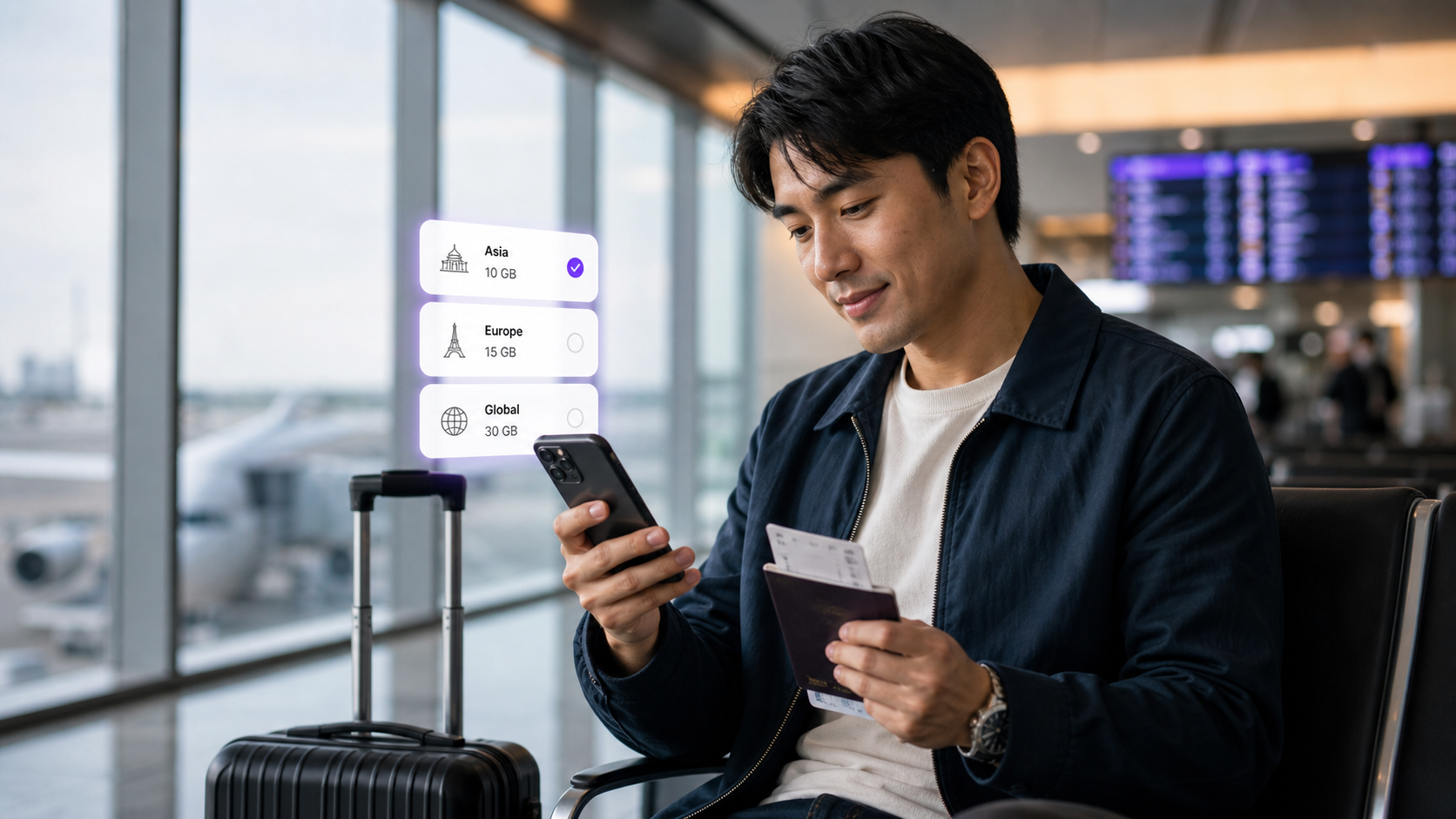
Traveler at the airport choosing the best eSIM plan on a smartphone before flying
Best eSIM for Travel: How to Choose the Right Plan Before You Fly
Choosing the best eSIM for travel can make your trip easier before it even begins. Whether you are going on a short city break, a family holiday, a business trip, a road trip, or a multi-country journey, mobile data is one of the most important things to prepare before departure.
A good travel eSIM lets you stay connected abroad without changing physical SIM cards, searching for a local mobile shop, or relying on expensive roaming from your home operator. You can choose a prepaid data plan, install it digitally, and use mobile data when you arrive at your destination.
The best eSIM for travel is not always the cheapest option. It is the plan that fits your destination, trip length, data needs, phone compatibility, and travel style. This guide explains how to choose the right eSIM plan before you fly, so you can stay connected abroad with more control and less stress.
What is a travel eSIM?
A travel eSIM is a digital SIM that gives you mobile data while traveling abroad. Instead of inserting a physical SIM card into your phone, you install the eSIM digitally on a compatible device.
A travel eSIM can be used for maps, messaging apps, hotel bookings, ride-hailing apps, translation tools, email, social media, and browsing while abroad. Many travel eSIM plans are prepaid, which means you choose your data amount and validity period before using the service.
If you are new to eSIM technology, start with our guide explaining what a travel eSIM is and how it works. It explains the basics of eSIM installation, activation, and mobile data use abroad.
Why choosing the right eSIM matters
Choosing the right travel eSIM matters because every trip is different. A weekend in one city does not require the same plan as a three-week route across several countries. A traveler using maps and messages needs less data than someone working remotely, sharing hotspot, or uploading videos.
The right eSIM plan can help you:
- avoid unexpected roaming charges
- get mobile data shortly after arrival
- keep your regular SIM card in your phone
- choose data based on your real usage
- avoid buying local SIM cards abroad
- stay connected across one or several destinations
- manage your travel internet before departure
Choosing the wrong plan can lead to running out of data, paying for more than you need, or discovering that the plan does not cover all the countries on your route.
Start with your destination
The first step is to choose an eSIM that covers where you are going. This sounds simple, but it is especially important for multi-country trips.
If you are visiting one country, a country-specific eSIM may be the best option. If you are traveling across several countries in the same region, a regional eSIM may be more practical. If your trip includes different continents or many destinations, a global eSIM may be a better fit.
For example:
- one country: choose a country-specific eSIM
- several European countries: choose a Europe or regional eSIM
- several continents: consider a global eSIM
- flexible travel route: choose a plan with wider coverage
You can browse duasim eSIM plans by destination and compare country, regional, and global options before your trip.
Country eSIM, regional eSIM, or global eSIM?
One of the most important choices is whether you need a country, regional, or global eSIM.
A country eSIM is usually best if you are staying in one destination. For example, if your whole trip is in Turkey, Albania, Spain, Japan, or the United States, a single-country plan may be enough.
A regional eSIM is useful if you are visiting several countries in one region. For example, a Europe eSIM plan can be a better choice if your trip includes multiple European countries.
A global eSIM can make sense if your trip includes several regions or continents. This can be useful for long journeys, business travel, digital nomads, cruises, or complex routes with many stops.
If your route is international and flexible, read our guide to global eSIM plans for worldwide travel to understand when a worldwide data plan is worth considering.
Check how much mobile data you need
The best eSIM for travel should match your data needs. Too little data can be frustrating. Too much data can mean paying for something you do not use.
As a simple guide:
- 1 GB to 3 GB: short trips, light use, maps, messages, basic browsing
- 3 GB to 10 GB: regular travel use, social media, travel apps, email, occasional calls
- 10 GB to 20 GB: longer trips, frequent app use, video calls, hotspot, uploads
- 20 GB or more: remote work, heavy hotspot, streaming, long stays, digital nomad use
Your data needs depend on how you use your phone. Maps, messages, and email usually use less data. Video streaming, social media videos, hotspot, cloud backups, and video calls use much more.
Before choosing a plan, read our guide on how much mobile data you need when traveling abroad. It explains common travel data use and helps you choose a better eSIM data plan.
Think about trip length and validity
A good travel eSIM should last for the full length of your trip. Data amount is important, but validity period is just as important.
Before buying, check:
- how many days the plan is valid
- when the validity period starts
- whether the plan covers your whole trip
- whether you need data on travel days
- whether your trip may be extended
- whether you are visiting several destinations
For a weekend trip, a short-validity plan may be enough. For a two-week holiday or business trip, choose a plan that covers the entire period. For longer travel, remote work, or flexible routes, consider a larger plan or broader coverage.
The goal is to avoid having your eSIM expire before your trip ends.
Check if your phone supports eSIM
Before choosing any travel eSIM, make sure your phone supports eSIM technology. Many newer iPhones, Samsung Galaxy devices, Google Pixel phones, and other modern smartphones support eSIM, but compatibility depends on the device model and sometimes the region where the phone was purchased.
You can check if your phone supports eSIM before buying a plan.
Your phone should also be unlocked and updated. If your device is locked to one mobile operator, it may not be able to use another mobile data plan abroad.
Checking compatibility before departure is important because an eSIM cannot be inserted physically like a traditional SIM card. Your device must support digital eSIM installation.
Choose prepaid pricing for better control
A prepaid eSIM is often one of the easiest ways to control mobile data costs abroad. Instead of waiting for a roaming bill after your trip, you choose your plan before you travel.
Prepaid eSIM plans can help you:
- know the cost before using data
- avoid surprise roaming bills
- choose data based on your trip
- separate travel data from your normal mobile plan
- manage mobile data more intentionally
This is especially useful if you are traveling outside your home region, visiting a country with expensive roaming, or using mobile data often during the trip.
If your goal is to reduce travel mobile costs, read our guide on how to avoid roaming charges when traveling abroad.
Compare eSIM and roaming before you decide
Roaming can be convenient because it uses your existing mobile plan. But it is not always the cheapest or clearest option.
Some mobile plans include roaming in certain countries. Others charge daily fees, destination-zone rates, or expensive pay-as-you-go data prices. This can make the final cost difficult to predict.
A travel eSIM can be better if you want prepaid pricing, a dedicated data plan for your destination, and more control over mobile data abroad.
Before choosing between eSIM and roaming, compare:
- your destination
- your operator’s roaming rates
- your expected data use
- your trip length
- whether your phone supports eSIM
- whether you are visiting one country or several
- whether roaming is already included in your plan
For a deeper comparison, read our guide to eSIM vs roaming for international travel.
Make sure the plan fits how you travel
The best eSIM for travel depends on your travel style.
A tourist may mainly need maps, messaging, restaurant searches, and booking apps. A business traveler may need email, calendars, video calls, work tools, and reliable data shortly after arrival. A digital nomad may need more data, hotspot, cloud tools, and flexible coverage across several destinations.
Families may need enough data for navigation, communication, and sharing travel information. Backpackers may need regional coverage and flexible data across many countries. Road-trippers may need reliable mobile data for navigation and accommodation changes.
Before buying a plan, think honestly about how you will use your phone during the trip.
Look at coverage, not only price
The cheapest eSIM is not always the best eSIM for travel. A better plan is one that fits your route, covers your destinations, gives enough data, and is easy to install.
Before choosing, check:
- included countries
- data amount
- validity period
- device compatibility
- installation method
- hotspot support if needed
- support information
- whether the plan is country, regional, or global
A plan with the right coverage and enough data can be better value than a cheaper plan that does not fit your actual trip.
Install your eSIM before you fly
It is usually best to install your travel eSIM before departure while you still have stable Wi-Fi. This gives you time to complete the setup, check your phone settings, and avoid rushing after arrival.
A simple preparation process is:
- Choose the right eSIM plan for your destination.
- Check that your phone supports eSIM.
- Install the eSIM while connected to Wi-Fi.
- Keep your regular SIM active if you want to use your normal number.
- Select the eSIM for mobile data when you are ready to use it.
- Enable data roaming for the eSIM line if required by the plan.
If you need help with installation or activation, visit the duasim eSIM FAQ and support page.
Keep your regular SIM card in your phone
One advantage of using a travel eSIM is that you can often keep your regular SIM card in your phone. Many modern smartphones support dual SIM functionality, allowing you to keep your normal number active while using your eSIM for mobile data abroad.
This can be helpful if you need to receive calls, SMS, or bank verification codes on your usual number while using a separate data plan for travel.
Before departure, check your phone settings so your eSIM is selected for mobile data and your primary SIM does not accidentally use roaming data.
Check whether hotspot is supported
Hotspot can be useful while traveling, especially for laptops, tablets, remote work, or sharing data with another device. But hotspot can also use data quickly.
Before choosing a plan, check whether hotspot sharing is supported and think about how much data you may need.
You may need more data if you plan to:
- work from your laptop
- share data with family or friends
- use your phone as backup internet
- take video calls
- upload or download files
- connect tablets or other devices
If hotspot is important for your trip, choose a larger data plan and monitor usage carefully.
Avoid common eSIM mistakes
Choosing the wrong travel eSIM usually happens when travelers focus only on price or forget to check important details.
Common mistakes include:
- buying a plan that does not cover every destination
- choosing too little data
- ignoring the validity period
- not checking phone compatibility
- installing the eSIM too late
- leaving the wrong SIM selected for mobile data
- forgetting to turn off roaming on the primary SIM
- assuming every plan supports hotspot
- relying only on public Wi-Fi
A few minutes of preparation before your trip can prevent most of these problems.
Best eSIM for Europe travel
If you are traveling through Europe, a regional eSIM can be one of the most practical options. Europe is common for multi-country trips, train travel, road trips, cruises, city breaks, and business routes.
Instead of buying a separate SIM card in each country, a regional plan can give you mobile data across several destinations.
If your trip includes multiple European countries, read our guide to the best eSIM for Europe travel. It explains when one Europe eSIM plan can be more convenient than several local SIM cards.
Best eSIM for business travelers
Business travelers often need reliable mobile data as soon as they arrive. Email, calendars, ride-hailing apps, maps, messaging, document access, and video calls can all be important during a work trip.
For business travel, choose an eSIM plan that has enough data for work tools and covers the full trip. If you use hotspot or video calls, choose more data than a light traveler would need.
A prepaid eSIM can also help separate travel data from your normal mobile plan, which makes costs easier to manage.
Best eSIM for digital nomads
Digital nomads often need more flexibility than short-term tourists. If you work while traveling, you may need larger data plans, hotspot support, regional or global coverage, and a backup connection when Wi-Fi is unreliable.
A global or regional eSIM can be useful if you move between countries often. It can reduce the need to buy new local SIM cards in each destination and make travel connectivity easier to manage.
For digital nomads, the best eSIM is usually one that balances coverage, data amount, validity, and flexibility.
Why choose duasim for your travel eSIM?
duasim is built for travelers who want a simple way to stay connected abroad. Instead of dealing with physical SIM cards, unclear roaming costs, or public Wi-Fi dependence, you can choose a prepaid eSIM plan before you travel and prepare your mobile data in advance.
With duasim, you can:
- browse eSIM plans for destinations worldwide
- choose country, regional, or global coverage
- install your eSIM digitally
- keep your regular SIM card in your phone
- use mobile data abroad without changing plastic SIM cards
- manage your travel connectivity more easily
For easier access on your phone, you can also download the duasim app and manage your eSIMs while traveling.
Conclusion: the best eSIM for travel is the one that fits your trip
The best eSIM for travel is not the same for every traveler. It depends on where you are going, how long you are staying, how much data you need, and whether you are visiting one country or several destinations.
For a short trip, a small country-specific eSIM may be enough. For a multi-country journey, a regional eSIM can be more practical. For complex routes across several regions, a global eSIM may be the better choice.
Before you fly, check that your phone supports eSIM, compare your destination options, estimate your data needs, and choose a plan that covers your full trip. With duasim, you can find the right prepaid eSIM plan for your next trip and travel with a simpler way to stay connected abroad.
FAQ: Choosing the best eSIM for travel
What is the best eSIM for travel?
The best eSIM for travel is the plan that fits your destination, trip length, data needs, device compatibility, and travel style. For one country, a country-specific eSIM may be enough. For multiple countries, a regional or global eSIM may be better.
How do I choose the right eSIM plan?
Choose an eSIM plan by checking your destination, data needs, trip length, phone compatibility, coverage, validity period, and whether you need hotspot sharing.
Is a travel eSIM better than roaming?
A travel eSIM can be better than roaming if you want prepaid pricing, more control, and mobile data for your destination. Roaming may be suitable if your mobile plan already includes affordable international data.
How much data do I need for a travel eSIM?
Light travelers may need 1 GB to 3 GB, moderate users may need 3 GB to 10 GB, and heavy users may need 10 GB to 20 GB or more. Your needs depend on apps, trip length, hotspot use, video calls, and streaming.
Can I use one eSIM for multiple countries?
Yes, if you choose a regional or global eSIM that includes the countries you are visiting. Always check the included destinations before buying a plan.
Should I install my eSIM before I travel?
Yes, it is usually best to install your eSIM before departure while you have stable Wi-Fi. Then you can select it for mobile data when you are ready to use it abroad.
How do I know if my phone supports eSIM?
You can use the duasim eSIM compatibility checker to check whether your phone supports eSIM before buying a plan.
Where can I buy a travel eSIM?
You can browse duasim prepaid eSIM plans and choose a country, regional, or global plan for your next trip.