
eSIM vs Local SIM Card: Which Is Better for Travelers?
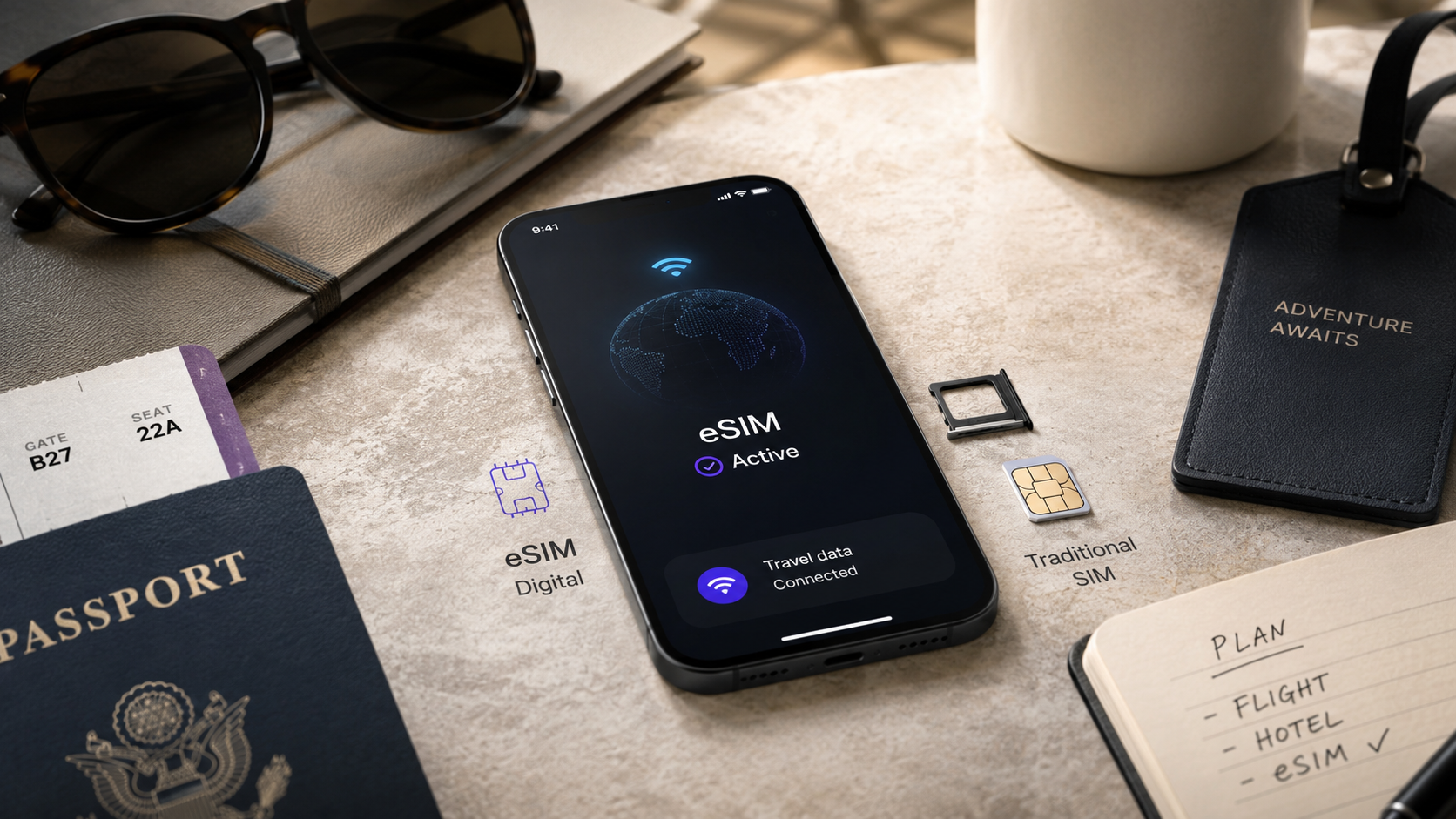
Smartphone with digital eSIM next to a physical SIM card for travel comparison
eSIM vs Local SIM Card: Which Is Better for Travelers?
Trying to choose between an eSIM vs local SIM card for your next trip? Both options can help you get mobile data abroad, but they solve the problem in different ways.
A local SIM card is a physical SIM you usually buy after arriving in your destination. An eSIM is a digital SIM you can buy online, install before you travel, and use for mobile data on a compatible phone. For many travelers, the choice comes down to convenience, cost control, setup time, phone compatibility, and whether you need a local phone number.
If you want internet while traveling for maps, messages, hotel bookings, transport apps, translation, email, and travel documents, both options can work. But if you want to avoid changing physical SIM cards, reduce arrival stress, and prepare your travel data before departure, a travel eSIM is often the easier choice.
This guide compares eSIM and local SIM cards fairly, explains when each option is better, and helps you choose the right mobile data solution for your trip.
If you are new to eSIM technology, start with our guide explaining what a travel eSIM is and how it works.
Quick comparison: eSIM vs local SIM card
Option | Best for | Main drawback |
|---|---|---|
Travel eSIM | Buying before travel, easy setup, short trips, multi-country travel | Requires an eSIM-compatible, unlocked phone |
Local SIM card | Longer stays, needing a local phone number, some local-only offers | Requires buying after arrival and changing physical SIM cards |
Roaming | Travelers whose home plan includes the destination | Can be expensive if not included |
Public Wi-Fi | Hotels, cafés, airports, and light browsing | Not reliable while moving around |
For many travelers, an eSIM is the most convenient local SIM card alternative because it gives you mobile data abroad without needing to find a SIM shop after arrival.
What is a travel eSIM?
A travel eSIM is a digital SIM plan that lets you use mobile data abroad on a compatible phone. Instead of inserting a plastic SIM card, you install the eSIM digitally using a QR code, app, or manual setup details.
A travel eSIM can help you use mobile data for:
- Maps and navigation
- Hotel and apartment check-ins
- Airport transfers
- Ride-hailing and taxi coordination
- Train, ferry, bus, and flight information
- Translation apps
- Restaurant searches and reviews
- WhatsApp, iMessage, Messenger, Telegram, and email
- Travel documents and booking confirmations
- Online banking and payment apps
- Remote work tools
Most travel eSIMs are mainly designed for data. That means you may not get a local phone number, but you can still use internet-based apps for messaging, calling, maps, bookings, translation, and work.
What is a local SIM card?
A local SIM card is a physical SIM card from a mobile provider in the country you are visiting. You usually buy it after arrival at an airport, mobile shop, convenience store, or kiosk, depending on the destination.
A local SIM card may include:
- Mobile data
- A local phone number
- Local calls and SMS
- Country-specific packages
- Prepaid validity options
Local SIM cards can be useful, especially for longer stays or if you need a local number. But they can also require more effort after arrival because you need to find a seller, compare plans, register if required, change your SIM card, and keep your home SIM safe.
Why many travelers prefer eSIM
A travel eSIM is popular because it removes several arrival-day problems. You can choose your plan before departure, install it on Wi-Fi, and use mobile data when you land.
You can buy before you fly
One of the biggest advantages of an eSIM is preparation. Instead of searching for a SIM card shop at the airport, you can buy eSIM online before your trip and get your mobile data ready in advance.
This is especially useful if you arrive late, have a short layover, need to contact a driver, or want maps immediately after landing.
You do not need to change physical SIM cards
With an eSIM, there is no plastic SIM card to insert, remove, lose, or store. This makes travel easier, especially if your main SIM card is important for calls, SMS, banking codes, WhatsApp, iMessage, or work communication.
A travel eSIM lets you keep your main SIM card in your phone while using a separate data plan abroad, if your device supports dual SIM use.
It is practical for short trips
If you are traveling for a weekend, a city break, a business trip, or a one-week holiday, buying a local SIM card after arrival may feel like too much effort. A travel eSIM is often simpler because the setup can be completed before you leave home.
It works well for multi-country trips
If your trip includes several countries, an eSIM can be especially useful. Instead of buying a new local SIM card in every destination, you can choose a country, regional, or global eSIM plan based on your route.
For example, if you are visiting several countries in Europe, compare Europe eSIM plans. If you are traveling across Asia, compare Asia Pacific eSIM plans. For wider international travel, browse options in the duasim eSIM store.
When a local SIM card may be better
A local SIM card is still useful in some situations. The best choice depends on your trip.
You need a local phone number
Many travel eSIM plans are data-only. If you need a local number for calls, SMS, local forms, deliveries, or services that require a domestic phone number, a local SIM card may be better.
You are staying for a long time
If you are staying in one country for several months, a local SIM card may offer packages designed for residents or long-term visitors. In that case, it may be worth visiting a mobile shop and comparing local options.
Your phone does not support eSIM
Not every phone supports eSIM. If your phone is not eSIM-compatible, a physical local SIM card may be your main option.
Before buying a travel eSIM, check your device with the duasim compatibility checker. You can also read our guide to eSIM compatible phones.
Your phone is locked
Even if your phone supports eSIM, it may need to be unlocked to use a travel eSIM from another provider. If your phone is locked to your home carrier, contact your provider before buying.
eSIM vs local SIM card: setup and convenience
Setup is where eSIMs often have the biggest advantage.
With a local SIM card, you may need to:
- Find a SIM seller after arrival
- Compare packages in a new country
- Show identification if required
- Remove your current SIM card
- Insert the new SIM card
- Store your home SIM safely
- Change settings manually
- Repeat the process if you travel to another country
With a travel eSIM, you usually:
- Choose your destination or region.
- Buy your plan online.
- Install the eSIM on Wi-Fi.
- Label it clearly, such as “Travel Data.”
- Set it as your mobile data line when you arrive.
If you use iPhone, follow our guide on how to install an eSIM on iPhone before you travel. If you use Android, read how to activate an eSIM on Android.
eSIM vs local SIM card: cost control
The cheapest option depends on the destination, trip length, data needs, and local market. A local SIM card may sometimes be cheaper for long stays or heavy local usage. A travel eSIM may be better if you value convenience, prepaid data, and setup before departure.
A prepaid eSIM can help with cost control because you choose your plan before using it. You know the data amount, destination, and validity before you travel.
A local SIM can also be prepaid, but you may need to compare plans after arrival, and pricing may vary by airport, city, provider, or tourist package.
If your main goal is to avoid unpredictable roaming, read our guide on how to avoid roaming charges when traveling abroad. You can also compare travel eSIM and roaming directly in our guide to eSIM vs roaming for international travel.
eSIM vs local SIM card: travel use cases
City breaks
For short city breaks, an eSIM is usually convenient. You can prepare before departure and use data immediately for maps, transport, hotels, restaurant searches, and messaging.
Beach holidays
For beach holidays, an eSIM can help with transfers, hotel communication, maps, bookings, restaurant searches, and sharing travel updates. If you are staying in one resort for a long period and need a local number, a local SIM may also make sense.
Road trips
For road trips, an eSIM is useful because you can have data ready before leaving the airport or rental car location. It can help with maps, fuel stops, hotels, road conditions, and route changes.
Multi-country travel
For multi-country travel, an eSIM is often more practical than buying local SIM cards in every destination. Regional eSIM plans can be useful for routes across Europe, Asia, the Balkans, the Nordics, or several countries in one trip.
Business travel
For business travelers, eSIMs are useful because setup can be done before travel. You can keep your main number active and use travel data for email, calendar apps, maps, ride coordination, cloud tools, and app-based calls.
Digital nomads and remote workers
Digital nomads may need both options depending on the trip. For frequent movement, a regional or global eSIM can be useful. For long stays in one country, a local SIM card may be worth considering if you need a local number or very large local data packages.
eSIM vs local SIM card for keeping your main number active
One of the biggest reasons travelers choose an eSIM is that they want to keep their main number active.
This can matter for:
- Banking verification codes
- WhatsApp and iMessage
- Work calls
- Family communication
- SMS login codes
- Two-factor authentication
- Emergency contact
With many modern phones, you can keep your main SIM active while using an eSIM for mobile data abroad. This gives you more flexibility than replacing your physical SIM card with a local SIM.
Just make sure your settings are correct. Use your travel eSIM for mobile data, and turn off data roaming on your main SIM if you do not want your home carrier to charge roaming fees.
How much data do you need?
Your data needs depend on how you use your phone.
Traveler type | Suggested data range | Best for |
|---|---|---|
Light traveler | 1GB–3GB | Maps, messages, email, light browsing |
Regular tourist | 5GB–10GB | Maps, social media, bookings, travel apps |
Multi-country traveler | 10GB–20GB | Navigation, transport apps, daily planning |
Business traveler | 10GB–20GB+ | Email, cloud tools, app-based calls |
Digital nomad | 20GB+ | Remote work, hotspot, uploads, video calls |
Maps and messaging usually use less data. Video calls, streaming, hotspot, social media videos, and cloud backups use much more.
Not sure which plan size to choose? Read our guide on how much mobile data you need when traveling abroad.
How to choose between eSIM and local SIM card
Choose a travel eSIM if you want:
- Mobile data ready before arrival
- No physical SIM card swap
- A simple setup for short trips
- A local SIM card alternative
- Data for maps, messages, bookings, and travel apps
- Regional or global options for multi-country travel
- To keep your main SIM card in your phone
Choose a local SIM card if you want:
- A local phone number
- Calls and SMS in the destination
- A long-term local plan
- A physical SIM option for a non-eSIM phone
- A country-specific package after arrival
For many travelers, the best option is simple: use a travel eSIM for mobile data abroad and keep your main number active for important communication.
How to get started with a duasim travel eSIM
A typical setup is simple:
- Open the duasim eSIM store.
- Choose your destination, region, or global plan.
- Check that the plan covers your full route.
- Choose the data amount and validity that fit your trip.
- Complete secure checkout.
- Install the eSIM using the instructions provided.
- Set the eSIM as your mobile data line when you arrive.
Before buying, check that your phone supports eSIM with the duasim compatibility checker.
You can also download the duasim app to manage your eSIMs, receive data usage alerts, and keep your travel data easier to control.
For setup and product questions, visit the duasim FAQ.
FAQ: eSIM vs local SIM card
Is an eSIM better than a local SIM card?
An eSIM is often better if you want to buy before travel, avoid changing physical SIM cards, and use mobile data immediately after arrival. A local SIM card may be better for long stays or if you need a local phone number.
Is an eSIM the same as a local SIM card?
No. An eSIM is digital and installed on your phone without a physical card. A local SIM card is a physical SIM you usually buy in the destination country.
Can I use an eSIM and my normal SIM at the same time?
In many cases, yes. Many modern phones support dual SIM use, allowing you to keep your normal number active while using a travel eSIM for mobile data.
Does a travel eSIM include calls and SMS?
Many travel eSIM plans are data-only. You can still use internet-based apps such as WhatsApp, iMessage, FaceTime, Messenger, Telegram, and email. Always check the plan details before buying.
Is a local SIM card cheaper than an eSIM?
Sometimes, especially for long stays or local packages. But an eSIM can be more convenient because you can buy it before travel, install it digitally, and avoid searching for a SIM card after arrival.
Is an eSIM good for multi-country travel?
Yes. A travel eSIM can be very useful for multi-country travel, especially if you choose a regional or global plan that covers your route.
Do I need an unlocked phone for a travel eSIM?
Yes, in most cases your phone should be unlocked and eSIM-compatible. Check your device before buying.
Should I buy an eSIM before I travel?
Yes, it is usually best to buy and install your eSIM before travel while you have reliable Wi-Fi. Then you can set it as your mobile data line when you arrive.
Conclusion: eSIM vs local SIM card — which should you choose?
When comparing eSIM vs local SIM card, the better choice depends on your trip. A local SIM card can be useful for long stays, local phone numbers, and travelers whose phones do not support eSIM. But for many modern travelers, a travel eSIM is the easier option.
An eSIM lets you buy mobile data before departure, install it digitally, keep your main SIM card in your phone, and avoid searching for a local SIM card after arrival. It is especially useful for short trips, business travel, city breaks, road trips, and multi-country travel.
Before your next trip, browse duasim eSIM plans, check your phone with the duasim compatibility checker, and choose the travel data option that fits your destination, device, and travel style.