
Global eSIM Guide: When a Worldwide Data Plan Makes Sense
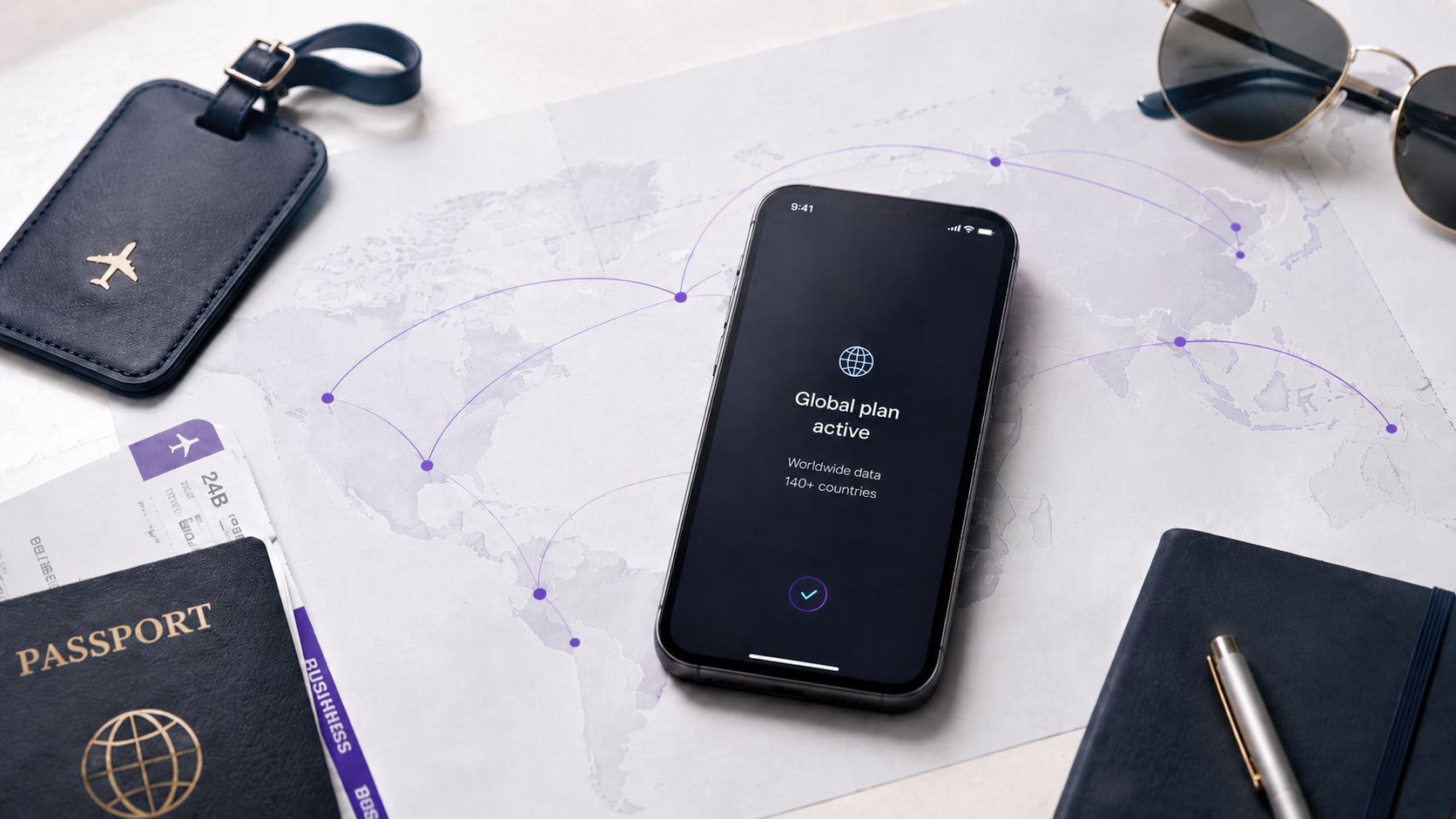
Smartphone showing a global eSIM data plan for travel across multiple countries
Global eSIM Guide: When a Worldwide Data Plan Makes Sense
Some trips are simple. You fly to one country, stay there for a few days, and return home. For that kind of journey, a country-specific eSIM may be enough.
But not every trip looks like that.
You might travel through several countries in Europe, combine Asia and the Middle East, visit family across different regions, take a cruise with multiple stops, or work remotely while moving between destinations. In those situations, a global eSIM can be a much simpler way to stay connected.
A global eSIM plan gives travelers mobile data across multiple destinations without buying a new SIM card in every country. Instead of managing several local SIM cards, comparing roaming rates, or switching plans every time your route changes, you can use one digital data plan designed for international travel.
This guide explains when a worldwide data plan makes sense, who should use one, and how to choose the right global eSIM before your next trip.
What is a global eSIM?
A global eSIM is a digital SIM plan that gives you mobile data in multiple countries or regions. Instead of being limited to one destination, a global eSIM is designed for travelers who need broader international coverage.
Like other eSIMs, a global eSIM is installed digitally on a compatible phone. You do not need to insert a physical SIM card, visit a local mobile shop, or replace your regular SIM card.
For travelers, this means you can prepare mobile data before departure and use your phone abroad for maps, messages, bookings, transport apps, translation tools, email, work tools, and browsing.
If you are new to eSIM technology, start with our guide explaining what a travel eSIM is and how it works. It explains the basics of eSIM setup, activation, and mobile data abroad.
When does a global eSIM make sense?
A global eSIM makes the most sense when your trip includes more than one country, region, or continent. It is especially useful when your route is flexible or when you do not want to buy a separate data plan for every destination.
A worldwide data plan may be a good choice if:
- you are visiting several countries on one trip
- your route includes multiple regions or continents
- you travel frequently for work
- you are a digital nomad
- you take cruises with several stops
- you often book last-minute trips
- you want one data solution for changing travel plans
- you want to avoid comparing roaming prices country by country
- you prefer managing one plan instead of several local SIM cards
For simple one-country trips, a country-specific eSIM may still be the better choice. For complex travel, a global eSIM can make the experience easier.
Global eSIM vs country eSIM
A country eSIM is designed for one specific destination. It can be a good choice if your trip is focused on one country only.
For example, if you are only visiting Albania, an Albania eSIM plan may be the most direct option. If you are only visiting Kosovo, a Kosovo eSIM plan may be more relevant than a broader plan.
A global eSIM is different. It is designed for travelers who need coverage across several countries or regions.
Choose a country eSIM if:
- you are visiting one country
- your trip is short and focused
- you know your route will not change
- you want a destination-specific data plan
Choose a global eSIM if:
- you are visiting several countries
- your trip includes different regions
- your route may change
- you travel often
- you want one plan for multiple destinations
The best choice depends on how simple or complex your trip is.
Global eSIM vs regional eSIM
A regional eSIM is designed for a group of countries in one area, such as Europe or the Balkans. A global eSIM is broader and may cover destinations across several regions.
A regional eSIM can be ideal if your trip stays within one area. For example, if you are traveling through several European countries, a Europe eSIM may be more practical than separate local SIM cards. Our guide to the best eSIM for Europe travel explains when one regional plan can make sense for multi-country Europe trips.
A global eSIM may be better if your trip crosses regions. For example, if you travel from Europe to Asia, from North America to Europe, or across several continents, a worldwide data plan may be easier to manage.
Choose a regional eSIM if:
- your trip stays within one region
- you are visiting several nearby countries
- your route is focused on one part of the world
- you want broader coverage than one country but not worldwide coverage
Choose a global eSIM if:
- your trip includes multiple regions
- you want one plan for several countries worldwide
- your travel route is flexible
- you travel internationally often
Global eSIM vs roaming
Roaming uses your existing mobile plan abroad. It can be convenient, but the cost and coverage depend on your home operator. Some operators include roaming in certain regions, while others charge daily fees, destination-zone rates, or pay-as-you-go data prices.
A global eSIM gives you a separate prepaid data plan for travel. You choose the plan before using mobile data abroad, which can make costs easier to control.
A global eSIM may be better than roaming if:
- you travel through several countries
- your operator charges high roaming rates
- your destination coverage is unclear
- you want prepaid pricing
- you want to avoid surprise roaming bills
- you need data across different regions
- you want to keep your regular SIM card in your phone
Roaming may still make sense if your current mobile plan already includes generous international data in all the countries you are visiting.
Before deciding, read our guide to eSIM vs roaming for international travel and compare your roaming options with a prepaid eSIM plan.
Global eSIM vs local SIM cards
Local SIM cards can work well for long stays in one country, but they are often less convenient for multi-country travel. You may need to find a mobile shop, compare local offers, show identification, and replace the SIM card already in your phone.
If you travel through several countries, this process can repeat multiple times.
A global eSIM is digital and can be prepared before your trip. It helps you avoid buying a new physical SIM card in every destination.
A global eSIM can be more convenient if:
- your trip includes several countries
- you want mobile data shortly after arrival
- you do not want to visit local mobile shops
- you want to keep your normal SIM card in your phone
- your route may change
- you prefer one digital setup for travel data
For long stays in one country, a local SIM or country eSIM may still be worth comparing. For multi-country travel, a global eSIM often gives more flexibility.
Who should use a global eSIM?
A global eSIM is useful for travelers who need broad coverage, flexible routes, or a simple way to manage mobile data across destinations.
It can be especially useful for:
- frequent international travelers
- business travelers
- digital nomads
- backpackers
- cruise passengers
- students abroad
- remote workers
- families visiting several countries
- travelers with flexible routes
- people combining several regions in one trip
If you travel only once or twice a year to one destination, a country-specific eSIM may be enough. But if your travel is more complex, a global eSIM can reduce the need to manage several separate data plans.
Global eSIM for business travel
Business travelers often need mobile data immediately after landing. Email, calendars, messaging apps, ride-hailing, maps, document access, and video calls can all be important during a work trip.
If your business travel includes several countries, a global eSIM can be useful because it gives you one data solution for multiple destinations. This can reduce the need to buy a new plan for every trip or rely on changing roaming rates.
A global eSIM may be especially useful for business travelers who:
- travel internationally often
- visit several countries in one month
- need backup mobile data
- use hotspot for a laptop
- want predictable prepaid data costs
- want to keep their regular phone number active
If you use video calls, hotspot, or cloud tools, choose enough data for work use, not only basic travel use.
Global eSIM for digital nomads
Digital nomads often move between countries and rely heavily on internet access. Wi-Fi is important, but it is not always reliable in airports, taxis, cafés, coworking spaces, hotels, apartments, or rural areas.
A global eSIM can be a useful backup or main travel data option, especially when moving between countries. It can help with maps, messaging, hotspot, work tools, cloud platforms, and communication.
Digital nomads may need more data than normal tourists. Video meetings, hotspot, file uploads, cloud storage, and online work tools can use a lot of data.
If you work while traveling, read our guide on how much mobile data you need when traveling abroad before choosing a global eSIM plan.
Global eSIM for cruises and multi-stop trips
Cruises and multi-stop trips are strong use cases for global eSIMs. Travelers often visit several countries in a short period, sometimes across different regions.
A cruise may include ports in different countries. A backpacking route may cross several borders. A business route may include multiple cities in different countries. A global eSIM can make these trips easier by reducing the number of separate plans you need to manage.
Before choosing a global eSIM for a cruise, check where you will actually need mobile data. eSIMs use mobile networks on land, so coverage at sea can differ from coverage in ports and cities.
A global eSIM can still be useful when you arrive at each destination and need maps, transport, messaging, bookings, and travel information.
Global eSIM for family visits and diaspora travel
Many people travel internationally to visit family, attend weddings, or spend longer periods abroad. These trips often include more than one country, especially when family and friends live across nearby regions.
For example, a traveler may visit Albania, Kosovo, Montenegro, and North Macedonia on the same trip. In that case, a country-specific plan may work for one destination, but a broader option may be more practical if the trip includes several countries.
If your route is focused on the Balkans, read our guide to the best Balkans eSIM before choosing between country, regional, and global options.
How much data do you need for a global eSIM?
The right amount of data depends on your travel style, trip length, and how you use your phone.
As a simple guide:
- 1 GB to 3 GB: short trips and light use
- 3 GB to 10 GB: regular travel use, maps, messaging, apps, and social media
- 10 GB to 20 GB: longer trips, hotspot, video calls, and frequent app use
- 20 GB or more: remote work, heavy hotspot, streaming, long stays, or complex travel
For global travel, it is often smart to choose more data than you would for a short city break. Multi-country trips usually involve more navigation, more booking changes, more transport apps, and more time away from reliable Wi-Fi.
If you plan to use hotspot, video calls, cloud tools, or social media heavily, choose a larger data plan.
What to check before choosing a global eSIM
Before buying a global eSIM, check the details carefully. Not every worldwide plan is the same.
Look at:
- included countries
- data amount
- validity period
- activation rules
- device compatibility
- hotspot support
- whether your phone is unlocked
- whether your route is fully covered
- whether a country or regional plan would be better
- support information
The best global eSIM is the one that matches your actual route. A plan with broad coverage is only useful if it includes the countries you will visit.
Check if your phone supports eSIM
Before buying a global eSIM, make sure your phone supports eSIM technology. Many newer iPhones, Samsung Galaxy devices, Google Pixel phones, and other modern smartphones support eSIM, but compatibility depends on the exact model, region, carrier lock status, and software version.
You can check if your phone supports eSIM before choosing a plan.
Your phone should also be unlocked. If your device is locked to one mobile operator, it may not accept another eSIM plan for travel.
For more detail, read our guide to eSIM compatible phones.
When should you install a global eSIM?
It is usually best to install your global eSIM before departure while you still have stable Wi-Fi. This gives you time to complete setup, check your settings, and avoid problems after arrival.
A practical setup process is:
- Choose your global eSIM plan.
- Check that your phone supports eSIM.
- Install the eSIM while connected to Wi-Fi.
- Label it clearly, such as “Travel,” “Global,” or “duasim”.
- Keep your regular SIM active if you need your normal number.
- Select the eSIM for mobile data when you are ready to use it.
- Enable data roaming for the eSIM line if required by the plan.
If you use iPhone, read our guide on how to install an eSIM on iPhone before you travel. If you use Android, read our guide on how to activate an eSIM on Android.
How to avoid roaming charges with a global eSIM
A global eSIM can help reduce roaming risk by giving you a separate prepaid data plan for travel. But you still need to manage your phone settings carefully.
To avoid unwanted roaming charges:
- turn off data roaming on your primary SIM
- select your global eSIM for mobile data
- disable automatic data switching if needed
- enable data roaming only for the eSIM line if required
- monitor your data usage
- use Wi-Fi for large downloads and backups
- check your mobile data line after crossing borders
For a full checklist, read our guide on how to avoid roaming charges when traveling abroad.
Global eSIM for Europe and beyond
A global eSIM can be useful if your trip starts in Europe but continues elsewhere. For example, you may visit several European countries, then continue to Turkey, the Middle East, Asia, North America, or another region.
If your entire trip is inside Europe, a Europe eSIM may be enough. But if your route includes several regions, a global plan can reduce the need to switch plans during the trip.
For Europe-only travel, read our guide to the best eSIM for Europe travel. For wider routes, compare Europe, regional, and global options before choosing.
Global eSIM for the Balkans and nearby regions
The Balkans are a good example of why broader coverage can matter. Many travelers visit Albania, Kosovo, Montenegro, Serbia, North Macedonia, Bosnia and Herzegovina, Croatia, and nearby countries on the same trip.
If your trip is focused on one country, a destination-specific plan may work well. For example, you can choose an Albania eSIM plan for Albania or a Kosovo eSIM plan for Kosovo.
If your trip includes several Balkan countries, compare country, regional, and global options before buying. Our guide to the best Balkans eSIM explains how to choose the right plan for a Balkan route.
Is a global eSIM always the best choice?
No. A global eSIM is not always the best choice. It is best when you need broad coverage or want one plan for multiple destinations.
If you are only visiting one country, a country-specific eSIM may be simpler. If you are only traveling within one region, a regional eSIM may be more suitable.
A global eSIM makes the most sense when the convenience of broad coverage is more important than choosing a narrow destination plan.
In simple terms:
- one country: choose a country eSIM
- one region: choose a regional eSIM
- several regions or flexible routes: consider a global eSIM
The right choice depends on your route.
How to choose the best global eSIM plan
To choose the best global eSIM plan, start with your actual itinerary.
Ask yourself:
- Which countries will I visit?
- Will I travel across one region or several regions?
- How long will the trip last?
- How much data do I need?
- Will I use hotspot?
- Will I work remotely?
- Do I need data immediately after arrival?
- Does my phone support eSIM?
- Is my phone unlocked?
- Would a country or regional plan be more suitable?
Once you know your route and data needs, you can compare prepaid eSIM plans by destination and choose the best option for your trip.
Why choose duasim for a global eSIM?
duasim is designed for travelers who want a simple way to stay connected abroad without changing physical SIM cards or depending on traditional roaming. You can choose a prepaid eSIM plan before your trip, install it digitally, and use mobile data while traveling.
With duasim, you can:
- browse prepaid eSIM plans for destinations worldwide
- choose country, regional, or global coverage
- install your eSIM digitally
- keep your regular SIM card in your phone
- use mobile data abroad without changing plastic SIM cards
- manage your travel connectivity more easily
For easier access on your phone, you can also download the duasim app and manage your eSIMs while traveling.
Conclusion: a global eSIM is best for flexible, multi-country travel
A global eSIM makes the most sense when your trip goes beyond one country or one simple route. If you are visiting multiple countries, crossing regions, traveling often, working remotely, taking a cruise, or keeping your itinerary flexible, a worldwide data plan can make staying connected much easier.
It can help you avoid buying local SIM cards in every destination, reduce dependence on public Wi-Fi, and give you more control than traditional roaming. You can prepare your mobile data before departure, keep your regular SIM card in your phone, and use one digital plan across supported destinations.
Before your next international trip, check that your phone supports eSIM, compare country, regional, and global options, and choose the plan that fits your route. With duasim, you can compare prepaid eSIM plans for worldwide travel and stay connected abroad with a simpler, more flexible data solution.
FAQ: Global eSIMs
What is a global eSIM?
A global eSIM is a digital data plan that can give you mobile data across multiple countries or regions. It is installed digitally on an eSIM-compatible device and does not require a physical SIM card.
When should I choose a global eSIM?
You should consider a global eSIM if your trip includes several countries, multiple regions, frequent travel, flexible routes, business travel, digital nomad work, or cruise stops.
Is a global eSIM better than a country eSIM?
A global eSIM is better for multi-country or multi-region trips. A country eSIM may be better if you are only visiting one destination.
Is a global eSIM better than roaming?
A global eSIM can be better than roaming if you want prepaid pricing, broader travel coverage, and more control over mobile data abroad. Roaming may still be suitable if your home plan already includes your destinations.
Can I use one global eSIM in several countries?
Yes, if the global eSIM plan includes the countries you are visiting. Always check the included destinations before buying.
How much data do I need for a global eSIM?
Light travelers may need 1 GB to 3 GB, regular users may need 3 GB to 10 GB, and heavy users or remote workers may need 10 GB to 20 GB or more. Your needs depend on trip length, apps, hotspot, video calls, and streaming.
Can I keep my normal SIM card while using a global eSIM?
In many cases, yes. Many modern phones allow you to keep your regular SIM active while using a global eSIM for mobile data abroad.
Where can I buy a global eSIM?
You can browse duasim prepaid eSIM plans and choose a country, regional, or global plan for your trip.