
Nordic eSIM Guide: Data for Norway, Sweden, Denmark, Finland and Iceland
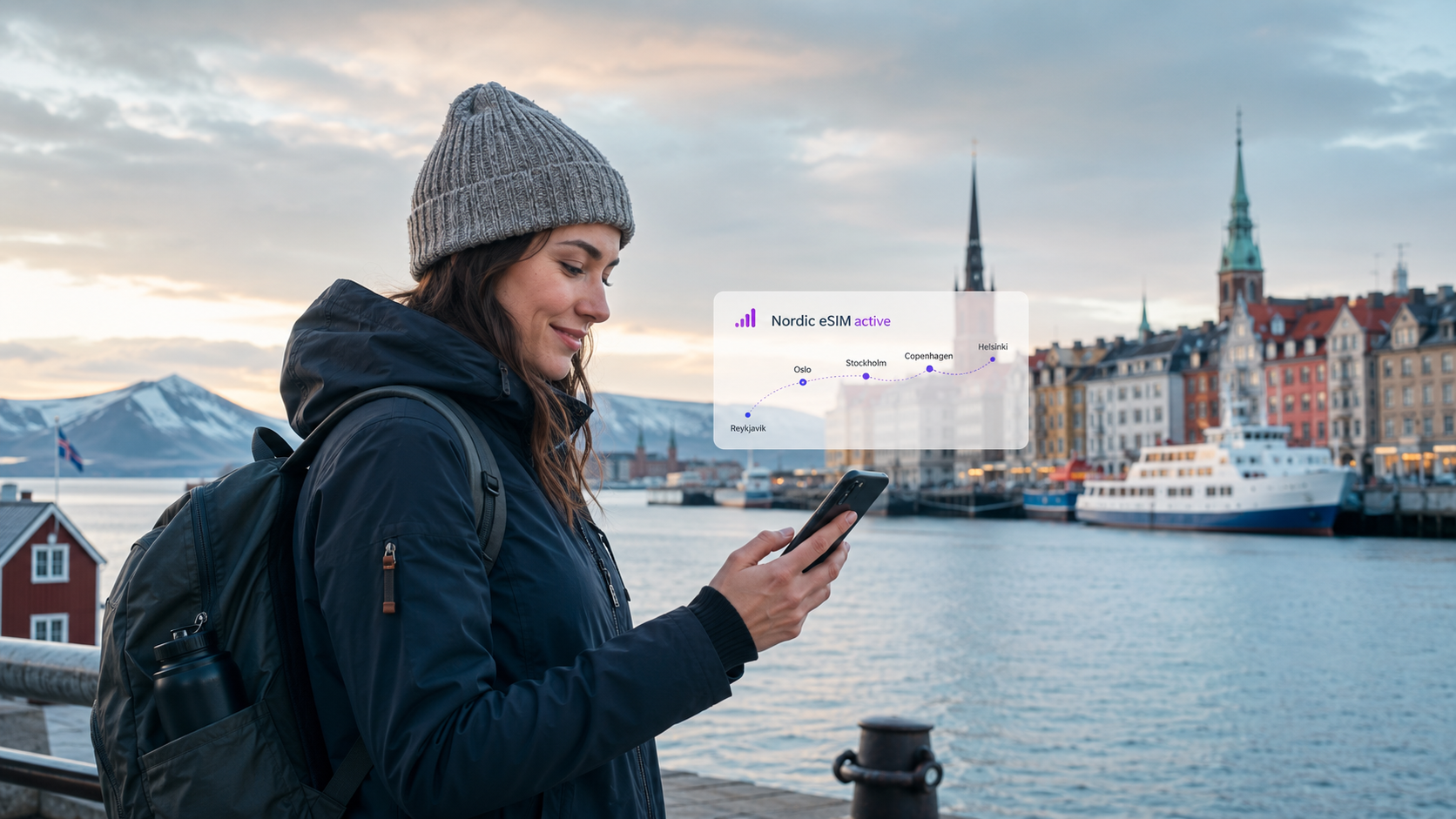
Traveler using a smartphone with a Nordic eSIM for data across Norway, Sweden, Denmark, Finland and Iceland
Nordic eSIM Guide: Data for Norway, Sweden, Denmark, Finland and Iceland
Planning a trip through the Nordics? Whether your route includes Norway’s fjords, Sweden’s cities, Denmark’s islands, Finland’s lakes, Iceland’s ring road, or the Faroe Islands, mobile data can make your journey much easier.
Nordic travel often means moving between cities, trains, ferries, airports, mountain roads, remote coastlines, national parks, and weather-dependent plans. You may need internet for maps, hotel check-ins, ferry tickets, train routes, rental cars, weather updates, translation, restaurant searches, messaging, and travel apps.
A Nordic eSIM can help you use mobile data across supported Nordic destinations without changing physical SIM cards in each country. For visitors planning a multi-country trip, it can be simpler than buying separate local SIM cards or relying only on roaming and public Wi-Fi.
In this guide, you will learn how to choose the best Nordic eSIM for your trip, when a regional plan makes sense, how Nordic roaming works, how much data you may need, and how to prepare your travel data before departure.
If you are new to eSIM technology, start with our guide explaining what a travel eSIM is and how it works. It explains the basics of digital SIM cards, mobile data abroad, setup, and using a travel eSIM while traveling.
Quick comparison: Nordic eSIM vs roaming vs local SIM
Option | Best for | Main drawback |
|---|---|---|
Nordic eSIM | Multi-country Nordic trips, road trips, ferries, easy mobile data | Requires an eSIM-compatible, unlocked phone |
Country eSIM | One-country trips, such as Norway-only or Iceland-only travel | Less practical if you visit several countries |
Local SIM card | Longer stays or needing a local number | Requires buying after arrival and changing SIM cards |
Roaming | Travelers whose home plan includes the Nordics | May have limits, fair-use rules, or extra costs depending on provider |
Public Wi-Fi | Hotels, airports, cafés, and light use | Not reliable while driving, hiking, sailing, or moving between places |
For many visitors, a Nordic eSIM is most useful when the trip includes more than one Nordic country or when you want mobile data ready from arrival.
What is a Nordic eSIM?
A Nordic eSIM is a regional digital mobile data plan that can work across supported Nordic destinations. Instead of inserting a physical SIM card, you install the eSIM digitally using a QR code, app, or manual setup details.
A travel eSIM for the Nordics can help you use mobile data for:
- Google Maps or Apple Maps
- Train, metro, ferry, and bus information
- Hotel and apartment check-ins
- Rental car navigation
- Weather and road condition updates
- Restaurant searches and travel recommendations
- Messaging apps
- Online tickets and booking confirmations
- Remote work tools
- Social media and content sharing
Most travel eSIMs are mainly designed for mobile data. That means you may not get a local phone number, but you can still use internet-based apps such as WhatsApp, iMessage, Messenger, Telegram, FaceTime, email, maps, and travel apps.
When a Nordic eSIM makes sense
A Nordic eSIM makes the most sense when your route includes several countries or remote travel where you want data ready before arrival.
For example, a regional Nordic plan may be useful if your itinerary includes:
- Norway and Sweden by train or car
- Denmark, Sweden, and Norway in one city-and-nature trip
- Finland and Sweden with ferry travel
- Iceland plus another Nordic destination
- Copenhagen, Malmö, Stockholm, and Oslo
- A cruise, road trip, or Arctic route
- The Faroe Islands as part of a wider Nordic journey
The main benefit is simplicity. You can prepare your travel data before departure, install one eSIM, and avoid setting up a new SIM solution each time your trip changes country.
When a country eSIM may be better
A regional Nordic eSIM is not always necessary. If your full trip is in one country, a country-specific eSIM may be simpler.
For example:
- Choose a Norway eSIM if your trip is only in Norway.
- Choose a Sweden eSIM if your trip is only in Sweden.
- Choose a Denmark eSIM if your trip is focused on Copenhagen and nearby areas.
- Choose a Finland eSIM if you are only visiting Helsinki, Lapland, or Finnish lakes.
- Choose an Iceland eSIM if your trip is only around Iceland.
If you are traveling across several Nordic countries, compare country plans with Nordic Countries eSIM plans before choosing.
Check the coverage list before buying
The most important rule with any regional eSIM is simple: check the exact country list before you buy.
Do not assume every “Europe,” “Scandinavia,” or “Nordic” eSIM covers the same destinations. Some plans may include Norway, Sweden, Denmark, Finland, and Iceland. Others may also include the Faroe Islands or nearby European countries. Some broader Europe plans may be better if your trip also includes Germany, France, the Netherlands, the Baltics, or the UK.
Before choosing a plan, ask:
- Does it cover every country on my route?
- Does it include Iceland or the Faroe Islands if I am going there?
- Does the validity match my full trip?
- Does the data amount fit my travel style?
- Does my phone support eSIM?
- Would a Europe plan be better for my full route?
For a Nordic-focused route, start by comparing Nordic Countries eSIM plans. If your trip also includes several non-Nordic European countries, compare with Europe eSIM plans.
Where mobile data is useful in the Nordics
Norway: fjords, roads and remote nature
Norway is one of the strongest reasons to plan mobile data carefully. Travelers often move between Oslo, Bergen, Stavanger, Trondheim, Tromsø, Lofoten, fjords, ferries, mountain roads, and national parks.
Mobile data can help with maps, ferry times, road closures, weather updates, hotel check-ins, electric car charging apps, hiking routes, restaurant searches, and Northern Lights alerts. In remote areas, signal can vary, so it is smart to save key maps and booking details offline.
Sweden: cities, trains and long distances
Sweden is easy to travel by train, but the distances can be long. Mobile data is useful in Stockholm, Gothenburg, Malmö, Uppsala, Kiruna, and Swedish Lapland.
Use data for train updates, metro routes, restaurant searches, museum tickets, hotel details, maps, ride coordination, and messaging. If you travel north for winter activities or nature, download important information before leaving major towns.
Denmark: Copenhagen, islands and short trips
Denmark is compact but very app-friendly for visitors. In Copenhagen, mobile data helps with metro routes, bike rentals, hotel check-ins, restaurant bookings, canal tours, maps, and travel between neighborhoods such as Nyhavn, Vesterbro, Nørrebro, Christianshavn, and Frederiksberg.
If your route includes Aarhus, Odense, Skagen, Bornholm, or ferry travel, mobile data helps with tickets, transport, and local planning.
Finland: Helsinki, lakes and Lapland
In Finland, mobile data is useful for Helsinki city travel, train routes, hotel check-ins, ferries, lakeside trips, and Lapland adventures. Travelers visiting Rovaniemi, Levi, Saariselkä, or northern winter destinations often rely on weather updates, maps, transport information, and tour communication.
If you are visiting Lapland, save key details offline because travel can involve remote routes, winter conditions, and long transfers.
Iceland: ring road, weather and road conditions
Iceland is one of the most data-dependent travel destinations in the Nordics. Visitors often drive long distances, check weather frequently, follow road condition updates, and use maps for waterfalls, lagoons, viewpoints, hotels, and guesthouses.
Mobile data is useful in Reykjavik, the Golden Circle, South Coast, Snæfellsnes, Akureyri, and the Ring Road. Because weather and road conditions can change quickly, having data available can make planning much easier. Still, always save maps and booking details offline before driving in remote areas.
Faroe Islands: ferries, villages and changing weather
The Faroe Islands are a unique Nordic destination where travelers often move between islands, tunnels, ferries, villages, viewpoints, and hiking areas. Mobile data helps with ferry information, maps, weather updates, hotel details, restaurant searches, and route planning.
Because weather can shift quickly, mobile data can be especially useful for checking plans during the day.
Nordic eSIM vs roaming
Roaming uses your home mobile provider while you are abroad. For many EU and EEA travelers, roaming in the Nordics may already be included under “roam like at home” rules. This can be convenient if your plan includes enough data and fair-use limits are not a problem.
However, roaming is not automatically the best option for every traveler. If you are visiting from outside Europe, if your plan has limited international data, or if your route includes countries with different roaming rules, a prepaid Nordic eSIM may give you more control.
A Nordic eSIM may be better if you want:
- A prepaid data option before you travel
- One plan for several supported Nordic destinations
- Mobile data without changing physical SIM cards
- Internet for maps, ferries, trains, hotels, and weather
- A practical alternative to roaming
- A simple setup for multi-country travel
Roaming may still be fine if your home plan clearly includes every destination on your route at no extra cost. Before relying on roaming, check data allowance, fair-use rules, speed limits, and possible fees.
To reduce the risk of unexpected costs, read our guide on how to avoid roaming charges when traveling abroad. You can also compare both options in our guide to eSIM vs roaming for international travel.
Nordic eSIM vs local SIM cards
Local SIM cards can work well for longer stays in one Nordic country. But if you travel across several countries, buying a local SIM card in each destination can become inconvenient.
Local SIM cards may require you to:
- Find a mobile shop or SIM retailer
- Compare local packages
- Show identification
- Change your physical SIM card
- Store your home SIM safely
- Repeat the setup if you change countries
A regional Nordic eSIM is usually simpler if you mainly need mobile data and your phone supports eSIM. You can buy before your trip, install digitally, and keep your main number active if your phone supports dual SIM.
If you want a prepaid data-first option, read our guide to the best prepaid eSIM for travel.
How much data do you need for Nordic travel?
The right data amount depends on trip length, country count, and how heavily you use your phone.
Traveler type | Suggested data range | Best for |
|---|---|---|
Light traveler | 1GB–3GB | Maps, messages, email, light browsing |
City-break traveler | 3GB–7GB | Public transport, tickets, bookings, restaurant searches |
Multi-country traveler | 10GB–20GB | Trains, ferries, maps, hotels, daily planning |
Road-trip traveler | 10GB–20GB+ | Navigation, weather, ferry updates, research |
Business traveler | 10GB–20GB+ | Email, cloud tools, app-based calls |
Digital nomad | 20GB+ | Remote work, hotspot, uploads, video calls |
If you mostly use maps, messaging, email, and light browsing, a smaller plan may be enough. If you use hotspot, upload videos, stream content, or work remotely, choose more data.
Not sure which plan size to choose? Read our guide on how much mobile data you need when traveling abroad.
How to set up a Nordic eSIM before your trip
A typical setup is simple:
- Open the duasim eSIM store.
- Choose Nordic Countries, Europe, or a country-specific plan.
- Check that every destination on your route is included.
- Select the data amount and validity that fit your trip.
- Complete secure checkout.
- Install the eSIM using the instructions provided.
- Label the eSIM clearly, for example “Nordic Data” or “duasim Travel.”
- Set the eSIM as your mobile data line when you arrive.
Before buying, check that your phone supports eSIM. You can use the duasim compatibility checker or read our guide to eSIM compatible phones.
If you use iPhone, follow our guide on how to install an eSIM on iPhone before you travel. If you use Android, read our guide on how to activate an eSIM on Android.
For general setup and product questions, visit the duasim FAQ.
Tips for saving mobile data in the Nordics
To make your travel data last longer:
- Download offline maps before your trip.
- Save hotel addresses and booking confirmations offline.
- Download train, ferry, flight, and attraction tickets before arrival.
- Use Wi-Fi for large uploads and video calls.
- Turn off automatic app updates on mobile data.
- Disable cloud photo and video backup while traveling.
- Reduce video quality on streaming apps.
- Download playlists, podcasts, and shows before flying.
- Save screenshots of ferry times, road routes, and booking details.
- Track your data usage during the trip.
These habits are especially useful when driving in Iceland, traveling through Norwegian fjords, visiting Lapland, taking ferries, or moving between Nordic countries.
You can also download the duasim app to manage your eSIMs, receive data usage alerts, and keep your travel data easier to control.
Is a Nordic eSIM good for tourists?
Yes. A Nordic eSIM can be useful for tourists visiting several countries or traveling through remote areas where mobile data helps with maps, ferries, weather, transport, bookings, and communication.
It is especially useful if your itinerary includes Norway, Sweden, Denmark, Finland, Iceland, or the Faroe Islands in one trip.
Is a Nordic eSIM good for business travelers and remote workers?
Yes. A Nordic eSIM can also be useful for business travelers, freelancers, and remote workers.
You may need mobile data for:
- Calendar apps
- Maps
- Train and taxi coordination
- Hotel bookings
- Cloud documents
- Messaging apps
- App-based calls
- Backup internet when Wi-Fi is weak
If you plan to work remotely, choose more data than a light tourist would need. Use Wi-Fi for large uploads and long video calls when possible, and keep mobile data as a reliable backup.
Why choose duasim for Nordic travel?
A duasim travel eSIM is designed for travelers who want simple mobile data abroad without changing physical SIM cards. Through the duasim eSIM store, you can browse country, regional, and global options and choose the plan that fits your route.
duasim may be a good fit if you want:
- Regional eSIM plans for Nordic travel
- Mobile data for maps, ferries, trains, hotels, and weather updates
- No physical SIM card
- Flexible eSIM data plans
- App-based eSIM management
- Country, regional, and global eSIM options
Before buying, always check destination coverage, data amount, validity, phone compatibility, and activation instructions.
FAQ: Nordic eSIM
What is the best Nordic eSIM for travel?
The best Nordic eSIM is the one that covers every destination on your route, gives you enough data, matches your travel dates, works with your phone, and is easy to install before departure.
Can I use one eSIM for Norway, Sweden, Denmark, Finland and Iceland?
Yes, if the regional eSIM plan includes those countries. Always check the exact coverage list before buying.
Does a Nordic eSIM work in the Faroe Islands?
Some Nordic plans may include the Faroe Islands, but you should always check the live coverage list before purchase.
Is a Nordic eSIM better than roaming?
A Nordic eSIM may be better if your home carrier charges roaming fees, has limited data, or does not include all destinations on your route. Roaming may still be fine if your provider includes every destination at no extra cost.
Is a Nordic eSIM better than a local SIM card?
A Nordic eSIM may be better if you are visiting several countries and want one digital setup before departure. A local SIM card may still be useful for longer stays in one country or if you need a local number.
How much data do I need for Nordic travel?
Light travelers may need 1GB–3GB. City-break travelers may need 3GB–7GB. Road-trip travelers, multi-country travelers, business travelers, remote workers, and heavy users may need 10GB–20GB or more.
Does a Nordic eSIM include calls and SMS?
Many travel eSIM plans are data-only, meaning they provide mobile internet but not a local phone number. You can still use apps like WhatsApp, iMessage, FaceTime, Messenger, Telegram, and email. Always check the live plan details before buying.
Can I use a Nordic eSIM on iPhone and Android?
Yes, if your phone supports eSIM and is unlocked. Check your exact device with the duasim compatibility checker before buying.
Should I install my Nordic eSIM before I fly?
Yes, it is usually best to install your eSIM before travel while you have reliable Wi-Fi. Then you can set it as your mobile data line when you arrive.
Conclusion: Choose your Nordic eSIM before your trip
A Nordic eSIM can make travel across Norway, Sweden, Denmark, Finland, Iceland, and the Faroe Islands easier by giving you mobile data across supported destinations with one digital setup.
It is especially useful if your trip includes fjords, ferries, trains, road trips, remote nature, city breaks, business travel, or several countries in one journey.
Before choosing a plan, check your itinerary, confirm every destination is covered, estimate your data needs, and make sure your phone is eSIM-compatible.
Before your trip, compare Nordic Countries eSIM plans, check your phone with the duasim compatibility checker, and get your travel data ready before you fly.