
Best Thailand eSIM for Travel: Internet for Tourists Without Roaming
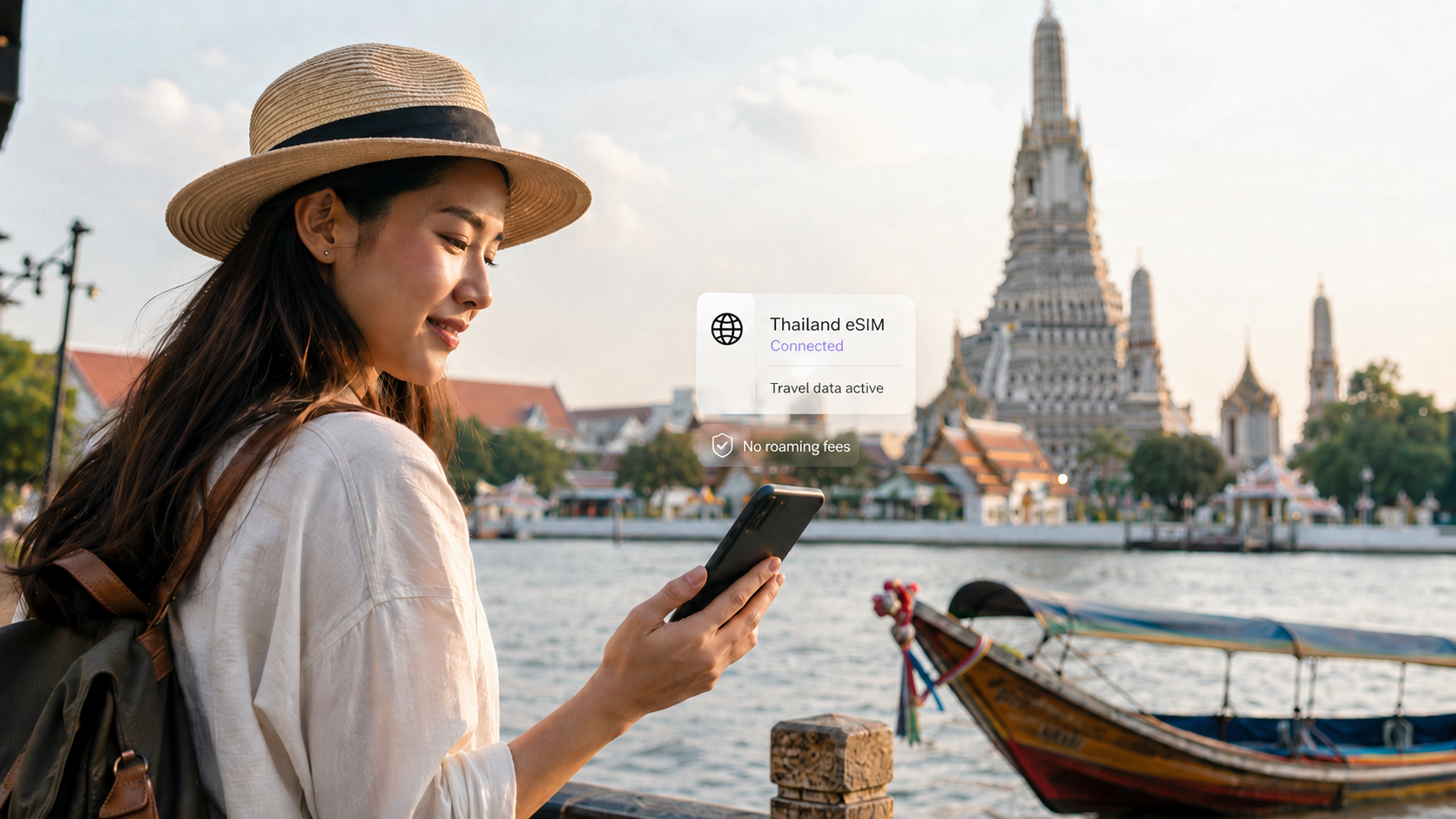
Traveler using a smartphone with a Thailand eSIM for internet access without roaming
Best Thailand eSIM for Travel: Internet for Tourists Without Roaming
Looking for a Thailand eSIM before your trip? Whether you are landing in Bangkok, relaxing in Phuket, exploring Chiang Mai, island-hopping around Krabi, visiting Koh Samui, or backpacking through northern Thailand, having mobile data ready when you arrive can make your journey much easier.
Thailand is a destination where travelers use their phones constantly. You may need internet for airport transfers, hotel check-ins, maps, translation, restaurant searches, ride-hailing, ferry tickets, tour bookings, messaging, and staying connected with family or work.
A prepaid eSIM for Thailand lets you buy travel data online, install it before departure, and use mobile data abroad without changing your physical SIM card. For tourists, backpackers, digital nomads, remote workers, and business travelers, this can be a simple alternative to roaming, airport SIM counters, or relying only on public Wi-Fi.
In this guide, you will learn how to choose the best Thailand eSIM for your trip, when an eSIM is better than roaming or a local SIM card, how much data you may need, and how to buy your travel eSIM from duasim before you fly.
If you are new to eSIM technology, start with our guide explaining what a travel eSIM is and how it works. It explains the basics of digital SIM cards, mobile data abroad, setup, and using a travel eSIM while traveling.
Quick comparison: Thailand eSIM vs roaming vs local SIM
Option | Best for | Main drawback |
|---|---|---|
Thailand eSIM | Tourists, backpackers, digital nomads, easy mobile data | Requires an eSIM-compatible, unlocked phone |
Local SIM card | Longer stays or needing a local number | Requires buying after arrival and changing SIM cards |
Roaming | Travelers whose home plan clearly includes Thailand | Can be expensive if Thailand is not included |
Public Wi-Fi | Hotels, cafés, airports, and light use | Not reliable while moving around |
For many visitors, a Thailand eSIM is the most convenient option because you can prepare before your trip and use mobile data when you arrive.
Why mobile data matters in Thailand
Thailand is easy to travel, but many parts of the trip become smoother when you have internet on your phone. You may arrive tired after a long flight, need to find your hotel, contact a driver, open a booking confirmation, translate a sign, or check the best route across the city.
In Bangkok, mobile data is useful for navigating BTS Skytrain, MRT, taxis, shopping areas, markets, temples, and hotel locations. In Phuket, Krabi, Koh Samui, Koh Phangan, and Koh Tao, it helps with transfers, boat schedules, beach directions, scooter routes, and accommodation check-ins. In Chiang Mai and Pai, data can help with maps, cafés, coworking spaces, day trips, and mountain routes.
A Thailand eSIM helps you stay connected from arrival instead of waiting until you find a SIM counter, mobile shop, or working Wi-Fi.
What is a Thailand eSIM?
A Thailand eSIM is a digital mobile data plan that works in Thailand on a compatible phone. Instead of inserting a physical SIM card, you install the eSIM digitally using a QR code, app, or manual setup details.
A travel eSIM for Thailand can help you use mobile data for:
- Google Maps or Apple Maps
- Hotel and apartment check-ins
- Ride-hailing and taxi coordination
- Ferry, bus, flight, and train information
- Restaurant searches and travel recommendations
- Translation apps
- WhatsApp, iMessage, Messenger, Telegram, LINE, and email
- Online banking and payment apps
- Tour bookings and digital tickets
- Remote work tools
- Social media and content sharing
Most travel eSIMs are mainly designed for mobile data. That means you may not get a local Thai phone number, but you can still use internet-based apps for messaging, calls, maps, bookings, and work.
How to choose the best Thailand eSIM for your trip
The best Thailand eSIM is not always the cheapest option. It should fit your route, phone, travel dates, data needs, and how you plan to use your device.
1. Check that the plan covers Thailand
Start by making sure the eSIM plan clearly covers Thailand.
For a Thailand-only trip, start with Thailand eSIM plans from duasim. If your trip also includes Japan, Singapore, Vietnam, Malaysia, South Korea, or other Asian destinations, compare Thailand-only plans with Asia Pacific eSIM plans from duasim.
2. Choose enough data for your travel style
Thailand travelers often use more data than expected because phones are used throughout the day for maps, transport, bookings, messaging, restaurant searches, and social media.
A short Bangkok city break may need less data than a two-week island-hopping trip or a remote-work stay in Chiang Mai. If you plan to use hotspot, upload videos, stream content, or take video calls, choose more data than a light tourist would need.
Not sure which plan size to choose? Read our guide on how much mobile data you need when traveling abroad.
3. Check the validity period
If you are visiting Thailand for a few days, a short-validity plan may be enough. If you are staying for two weeks, one month, or longer, choose a plan that covers your full stay.
This is especially important for backpackers, winter travelers, remote workers, and digital nomads who may stay longer than a normal holiday.
4. Make sure your phone supports eSIM
Before buying, check that your phone is eSIM-compatible and unlocked. You can use the duasim compatibility checker to check your device before purchase.
You can also read our guide to eSIM compatible phones if you want to understand how to check eSIM support on iPhone, Samsung, Google Pixel, and other Android devices.
5. Install before you travel
It is usually best to install your eSIM while you have reliable Wi-Fi before departure. This is especially helpful for Thailand because you may want mobile data ready as soon as you land at Bangkok, Phuket, Chiang Mai, or Krabi airport.
If you use iPhone, follow our guide on how to install an eSIM on iPhone before you travel. If you use Android, read our guide on how to activate an eSIM on Android.
Thailand eSIM vs roaming
Roaming uses your home mobile provider while you are abroad. It can be convenient, but the cost depends on your provider, your home country, and whether Thailand is included in your roaming plan.
A Thailand eSIM may be better if you want:
- A prepaid data option before you travel
- More control over travel data costs
- Mobile data without changing physical SIM cards
- Internet in Thailand for maps, apps, bookings, and messages
- A practical alternative to roaming
- A simple setup for short-term or long-stay travel
Roaming may still be fine if your home plan clearly includes Thailand at no extra cost. Before you travel, check your provider’s roaming page and confirm the data allowance, daily fees, speed limits, and fair-use rules.
To reduce the risk of unexpected costs, read our guide on how to avoid roaming charges when traveling abroad. You can also compare both options in our guide to eSIM vs roaming for international travel.
Thailand eSIM vs local tourist SIM card
Thailand has local tourist SIM cards, and they can work well for some travelers. But for many visitors, buying a physical SIM after arrival can be less convenient than preparing an eSIM before departure.
A local Thailand travel SIM may require you to:
- Find a SIM counter or mobile shop
- Compare tourist SIM packages after arrival
- Show identification
- Change your physical SIM card
- Store your home SIM safely
- Spend time on setup at the airport or in a mall
A travel eSIM is usually simpler if you mainly need mobile data. You can buy it before your trip, install it digitally, and keep your main number active if your phone supports dual SIM.
If you want a prepaid data-first option, read our guide to the best prepaid eSIM for travel.
Where mobile data is useful in Thailand
Bangkok
In Bangkok, mobile data is useful from the moment you land. You may need maps from Suvarnabhumi or Don Mueang Airport, hotel directions, taxi coordination, BTS and MRT routes, restaurant searches, translation, and navigation around areas like Sukhumvit, Silom, Siam, Asok, Chinatown, Khao San Road, Ari, and Thonglor.
Bangkok is large and busy, so having data ready can make the first day much easier.
Phuket
In Phuket, mobile data helps with airport transfers, beach directions, hotel communication, scooter routes, restaurant searches, boat trips, and day tours. If you visit Patong, Kata, Karon, Rawai, Phuket Old Town, or nearby islands, data is useful for both navigation and bookings.
Krabi, Ao Nang and island travel
In Krabi, Ao Nang, Railay, Koh Phi Phi, Koh Lanta, and nearby islands, mobile data helps with ferry times, boat pickup details, hotel check-ins, beach routes, weather updates, and communicating with tour operators.
Island travel can involve moving between boats, vans, taxis, and hotels, so having mobile data can reduce stress.
Koh Samui, Koh Phangan and Koh Tao
For Gulf of Thailand islands, mobile data helps with ferry tickets, resort transfers, scooter navigation, restaurant searches, beach directions, and messaging. If you are going to Koh Phangan or Koh Tao, save key booking details offline as a backup.
Chiang Mai and northern Thailand
Chiang Mai is popular with tourists, remote workers, and digital nomads. Mobile data is useful for cafés, coworking spaces, ride-hailing, temples, markets, day trips, and routes to Doi Suthep, Chiang Rai, Pai, or mountain areas.
If you work remotely, choose a plan with enough data for backup internet when Wi-Fi is unreliable.
Pattaya, Hua Hin and shorter beach trips
For Pattaya, Hua Hin, and other beach destinations near Bangkok, mobile data helps with hotel check-ins, transport, maps, restaurant searches, and daily planning.
How much data do you need in Thailand?
The right data amount depends on your trip length and how you use your phone.
Traveler type | Suggested data range | Best for |
|---|---|---|
Light traveler | 1GB–3GB | Maps, messages, email, light browsing |
Regular tourist | 5GB–10GB | Maps, social media, bookings, travel apps |
Island traveler | 10GB–20GB | Navigation, messaging, bookings, photos |
Business traveler | 10GB–20GB+ | Email, cloud tools, app-based calls |
Digital nomad | 20GB+ | Remote work, hotspot, uploads, video calls |
Heavy content user | 30GB+ | Social video, streaming, hotspot, uploads |
If you mostly use maps, messaging, email, and light browsing, a smaller plan may be enough. If you use hotspot, upload videos, stream content, or work remotely, choose more data.
For a broader planning guide, read best eSIM for travel: how to choose the right plan before you fly.
How to set up a duasim eSIM for Thailand
A typical setup is simple:
- Go to duasim.com or open the duasim app.
- Search for Thailand.
- Select the data amount and validity that fit your trip.
- Complete secure checkout.
- Install the eSIM using the instructions provided.
- Label the eSIM clearly, for example “Thailand Data” or “duasim Travel.”
- Set the duasim eSIM as your mobile data line when you arrive.
- Keep your main number active if needed, but check roaming settings carefully.
This setup helps you use mobile data abroad without changing physical SIM cards.
For general questions about setup, compatibility, and eSIM use, visit the duasim FAQ.
Tips for saving mobile data in Thailand
To make your travel data last longer:
- Download offline maps before your trip.
- Save hotel addresses and booking confirmations offline.
- Use Wi-Fi for large uploads and video calls.
- Turn off automatic app updates on mobile data.
- Disable cloud photo and video backup while traveling.
- Reduce video quality on streaming apps.
- Download playlists, podcasts, and shows before flying.
- Save screenshots of ferry tickets, hotel details, and tour pickups.
- Use messaging apps instead of regular international calls.
- Track your data usage during the trip.
These habits are especially useful if you are island-hopping, moving between hotels, or using your phone heavily for maps, social media, and bookings.
You can also download the duasim app to manage your eSIMs, receive data usage alerts, and keep your travel data easier to control.
Is a Thailand eSIM good for tourists?
Yes. A Thailand eSIM can be useful for tourists who want mobile data immediately after arrival. Many visitors rely on maps, ride coordination, hotel bookings, ferry tickets, translation, restaurant searches, messaging apps, and social media throughout their trip.
A Thailand eSIM is especially useful if you are visiting several destinations, such as Bangkok, Phuket, Chiang Mai, Krabi, Koh Samui, Pattaya, or Koh Tao.
Is a Thailand eSIM good for digital nomads?
Yes. A Thailand eSIM can also be useful for digital nomads, freelancers, and remote workers.
Thailand is popular for longer stays, especially in places like Chiang Mai, Bangkok, Phuket, Koh Samui, and Krabi. Even if you mostly use hotel, apartment, or coworking Wi-Fi, mobile data can be a valuable backup.
You may need mobile data for:
- Calendar apps
- Maps
- Ride coordination
- Hotel and apartment bookings
- Cloud documents
- Messaging apps
- App-based calls
- Backup internet when Wi-Fi is weak
If you plan to work remotely, choose more data than a light tourist would need. Use Wi-Fi for large uploads and long video calls when possible, and keep mobile data as a reliable backup.
Why choose duasim for Thailand travel?
A duasim travel eSIM is designed for travelers who want simple mobile data abroad without changing physical SIM cards. Through the duasim eSIM store, you can browse plans by destination, choose the data amount that fits your trip, and manage your eSIM digitally.
duasim may be a good fit if you want:
- A prepaid eSIM for Thailand
- Mobile data for maps, messages, bookings, transport, and travel apps
- No physical SIM card
- Instant activation options
- Flexible eSIM data plans
- App-based eSIM management
- Country, regional, and global eSIM options
Before buying, always check destination coverage, data amount, validity, phone compatibility, and activation instructions.
FAQ: Thailand eSIM
What is the best Thailand eSIM for travel?
The best Thailand eSIM is the one that covers Thailand, gives you enough data for your trip, matches your travel dates, works with your phone, and is easy to install before departure.
Can I buy an eSIM for Thailand before I travel?
Yes. You can buy a prepaid eSIM Thailand plan online before your trip, install it on a compatible phone, and use it for mobile data when you arrive.
Does a Thailand eSIM work in Bangkok and Phuket?
Yes, if the plan covers Thailand, it is designed for mobile data use in supported areas across the country, including major destinations such as Bangkok and Phuket. Always check the live plan details before buying.
Does a Thailand eSIM include calls and SMS?
Many travel eSIM plans are data-only, meaning they provide mobile internet but not a local phone number. You can still use apps like WhatsApp, iMessage, FaceTime, Messenger, Telegram, LINE, and email. Always check the live plan details before buying.
Is a Thailand eSIM better than a local SIM card?
A Thailand eSIM may be better if you want to buy before departure, avoid changing physical SIM cards, and get mobile data ready for arrival. A local SIM card may still be useful for longer stays or if you need a local phone number.
Is a Thailand eSIM better than roaming?
A Thailand eSIM may be better if your home carrier charges roaming fees or does not include Thailand in your plan. Roaming may still be fine if your provider includes Thailand at no extra cost.
How much data do I need in Thailand?
Light travelers may need 1GB–3GB for maps and messaging. Regular tourists often choose 5GB–10GB. Island travelers, remote workers, and heavy users may need 20GB or more.
Can I use a Thailand eSIM on iPhone and Android?
Yes, if your phone supports eSIM and is unlocked. Check your exact device with the duasim compatibility checker before buying.
Should I install my Thailand eSIM before I fly?
Yes, it is usually best to install your eSIM before travel while you have reliable Wi-Fi. Then you can set it as your mobile data line when you arrive.
Conclusion: Buy your Thailand eSIM before you travel
A Thailand eSIM is a practical way to get mobile data for your trip without changing physical SIM cards, waiting at an airport SIM counter, or relying only on public Wi-Fi. It can help you use maps, bookings, ride coordination, translation, messages, email, and travel apps from the moment you arrive.
Before choosing a plan, check your itinerary, estimate your data needs, confirm your phone is eSIM-compatible, and choose a Thailand plan that fits your trip length and travel style.
Before your trip, visit duasim.com or open the duasim app to check compatibility, choose your Thailand eSIM plan, and buy your travel data before you fly.