
Best eSIM for Business Travel and Digital Nomads
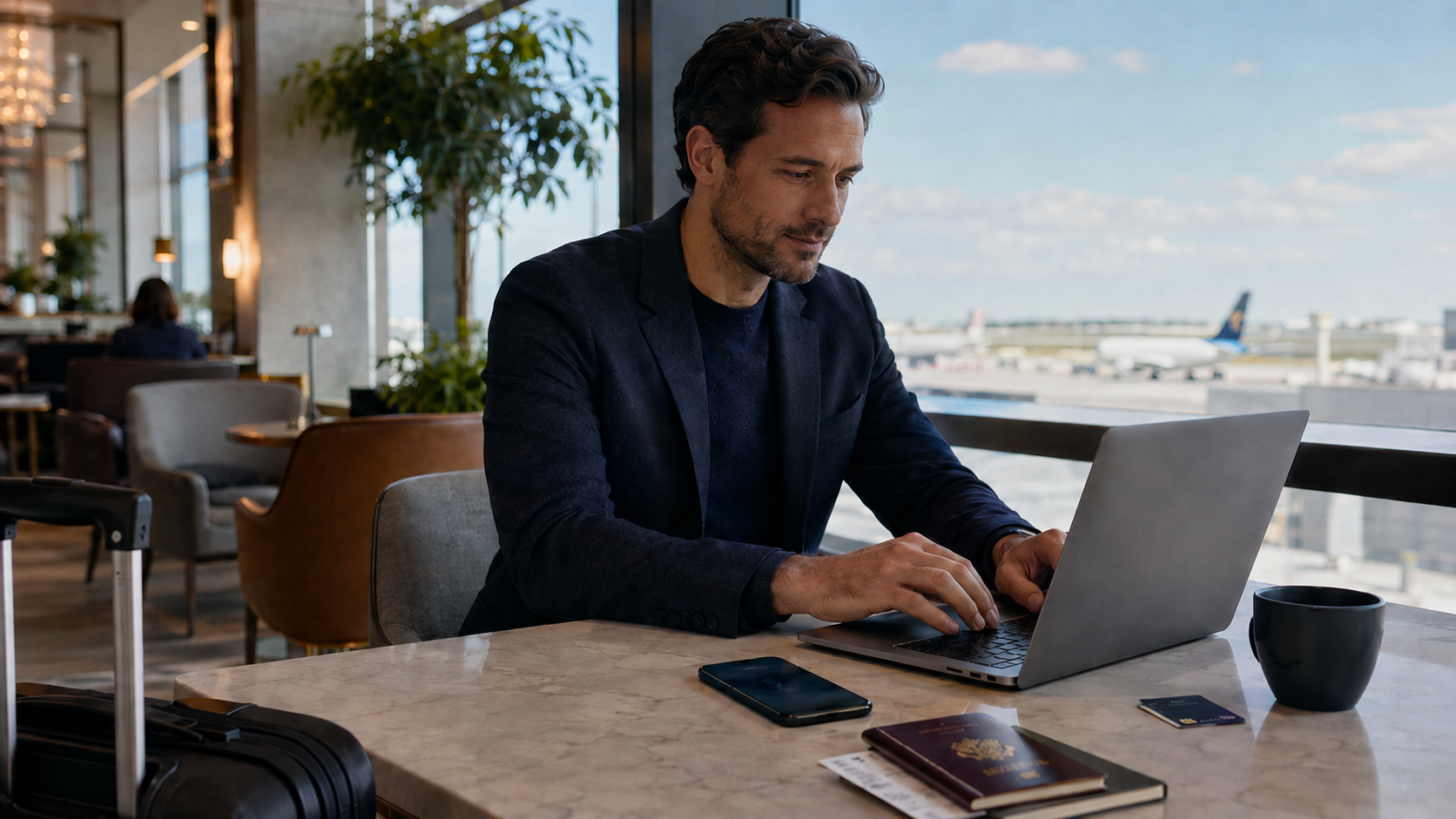
Business traveler using a smartphone and laptop with an eSIM for mobile data abroad
Best eSIM for Business Travel and Digital Nomads
Business travel and remote work both depend on one thing more than many people realize: reliable mobile data. Whether you are flying to a client meeting, working from a hotel, joining calls between cities, using maps between airports, or moving between countries as a digital nomad, being offline at the wrong moment can create stress.
That is why many travelers look for an eSIM for business travel before they leave. A travel eSIM lets you buy mobile data online, install it digitally, and use internet abroad without changing physical SIM cards. For business travelers, digital nomads, freelancers, founders, consultants, and remote workers, this can be a practical backup to hotel Wi-Fi, public networks, roaming, and local SIM cards.
The best eSIM for business travel and digital nomads is not always the cheapest plan. It should match your route, work style, data needs, device, and how often you move between countries. In this guide, you will learn how to choose the right eSIM data plan for work travel, when a global or regional eSIM makes sense, and what to check before your next trip.
If you are new to eSIM technology, start with our guide explaining what a travel eSIM is and how it works.
Quick comparison: eSIM options for work travel
Option | Best for | Main drawback |
|---|---|---|
Country eSIM | One work trip to one destination | Less practical for multi-country travel |
Regional eSIM | Several nearby countries, such as Europe or Asia | You must check the exact country list |
Global eSIM | Frequent flyers and multi-region travel | May not be necessary for one-country trips |
Local SIM card | Long stays or needing a local number | Requires buying after arrival and changing SIM cards |
Roaming | If your company or carrier plan includes the destination | Can be expensive or limited outside included zones |
For many work travelers, an eSIM is useful because it can be prepared before departure and used as soon as you arrive.
Why business travelers need reliable mobile data
Business travel often includes tight schedules. You may land, go straight to a meeting, find a hotel, check a train platform, message a colleague, open a calendar invite, or join a call from the back of a taxi.
Mobile data can help with:
- Airport transfers
- Maps and navigation
- Ride-hailing and taxi coordination
- Email and calendar apps
- Hotel check-ins
- Meeting location details
- Cloud documents
- Messaging apps
- App-based calls
- Translation
- Event and conference tickets
- Backup internet if Wi-Fi is weak
Hotel Wi-Fi can be useful, but it is not always available when you are moving. Airport Wi-Fi may require login steps. Conference Wi-Fi can be crowded. Café Wi-Fi may be unstable. A travel eSIM gives you an extra layer of control.
Why digital nomads need a different eSIM strategy
Digital nomads and remote workers often have different needs from short-trip tourists. Instead of using data only for maps and messages, they may need mobile internet for work tools, uploads, hotspot, calendar changes, client communication, and backup connectivity.
An eSIM for digital nomads can be useful if you:
- Move between countries often
- Work from hotels, apartments, cafés, or coworking spaces
- Need backup internet for calls
- Use cloud tools daily
- Travel with one phone but need flexible data
- Want to avoid buying a new local SIM in every country
- Need mobile data before your apartment or hotel Wi-Fi is ready
For a long stay in one country, a local SIM card may still make sense. But for frequent movement, a regional or global eSIM can be simpler.
Country, regional or global eSIM: which is best?
The best option depends on your travel pattern.
Choose a country eSIM for one destination
If your business trip is only in Germany, France, Japan, Thailand, Turkey, or another single country, a country-specific plan is often enough.
For example, if you only have meetings in Berlin and Frankfurt, a Germany plan may be better than a wider regional plan. If your trip is only in Tokyo and Osaka, a Japan plan may be enough.
Choose a regional eSIM for nearby countries
A regional eSIM can be useful if your route includes several countries in one area.
Examples:
- Europe business trip: France, Germany, Netherlands, Spain
- Asia work trip: Japan, South Korea, Singapore, Thailand
- Nordic work route: Norway, Sweden, Denmark, Finland
- Balkans route: Albania, Kosovo, Montenegro, Serbia
For multi-country routes, compare options in the duasim eSIM store. You can also read our guides to Asia eSIM plans for multi-country travel, Nordic eSIM plans, and Balkans eSIM plans.
Choose a global eSIM for frequent travel
A global eSIM can make sense if you travel often, visit several regions, or want one flexible option for multiple trips.
This can be useful for:
- Consultants
- Startup founders
- Sales teams
- Event professionals
- Frequent flyers
- Digital nomads
- Remote workers moving between regions
If your travel is wider than one country or region, read our global eSIM guide.
eSIM vs roaming for business travel
Roaming can be convenient, especially if your company mobile plan includes international data. But not every plan includes every destination, and some roaming plans have daily fees, data limits, speed restrictions, or fair-use rules.
A travel eSIM may be better if you want:
- A prepaid data option before you travel
- More control over data costs
- Mobile data without changing physical SIM cards
- A backup if company roaming is limited
- Separate travel data for work trips
- Regional or global options for multi-country travel
Roaming may still be fine if your provider clearly includes all destinations, gives enough data, and works well for your travel needs.
To compare both options, read eSIM vs roaming for international travel. To reduce the risk of unexpected costs, read how to avoid roaming charges when traveling abroad.
eSIM vs local SIM card for remote workers
A local SIM card can be useful if you stay in one country for a long time, need a local phone number, or want a local package after arrival. But for business travelers and digital nomads who move often, a travel eSIM is usually more convenient.
A local SIM card may require you to:
- Find a mobile shop
- Compare local plans
- Show identification
- Change your physical SIM card
- Store your home SIM safely
- Repeat the process in the next country
An eSIM lets you prepare before departure, keep your physical SIM in place, and use mobile data abroad with a digital setup.
For a full comparison, read eSIM vs local SIM card: which is better for travelers?.
Keeping your main number active while working abroad
Business travelers and remote workers often need their main number for important services.
You may need it for:
- Banking verification codes
- Work logins
- Two-factor authentication
- iMessage and FaceTime
- Client calls
- Family communication
- Emergency contact
Many modern phones allow you to keep your main number active while using a travel eSIM for mobile data. This is one of the biggest advantages of eSIM for work travel.
The safest setup is usually:
- Main SIM: keep active for calls or SMS if needed
- Travel eSIM: use for mobile data
- Main SIM data roaming: off, if you want to avoid roaming data charges
- Travel eSIM data roaming: follow the plan instructions
- Mobile data line: travel eSIM
For detailed setup advice, read how to keep your main number active while using a travel eSIM.
How much data do business travelers and digital nomads need?
Work travelers often need more data than light tourists. The right amount depends on how much you rely on mobile data instead of Wi-Fi.
Traveler type | Suggested data range | Best for |
|---|---|---|
Light business traveler | 3GB–5GB | Email, maps, messaging, calendar apps |
Regular business traveler | 5GB–10GB | Daily maps, email, app-based calls, documents |
Conference traveler | 10GB–20GB | Event apps, messaging, uploads, backup data |
Remote worker | 10GB–20GB+ | Work tools, hotspot, video calls when needed |
Digital nomad | 20GB+ | Longer stays, hotspot, uploads, regular remote work |
Video calls, hotspot, cloud backups, file uploads, and streaming use much more data than maps and messages. If your work depends on mobile data as backup internet, choose more data than a normal tourist would.
For more help, read how much mobile data you need when traveling abroad.
Hotspot, video calls and backup internet
Many business travelers and digital nomads care about hotspot use because it can turn a phone into backup internet for a laptop or tablet.
A travel eSIM can be useful for:
- Sending urgent emails from a laptop
- Joining a short call when hotel Wi-Fi fails
- Uploading a document before a deadline
- Using maps and calendar apps while moving
- Working during delays or layovers
- Staying connected between meetings
However, hotspot and video calls can use data quickly. If you plan to rely on hotspot, choose a larger data plan and use Wi-Fi for heavy tasks when possible.
Security tips for working while traveling
Mobile data can also be useful because it reduces dependence on unknown public Wi-Fi networks. Public Wi-Fi can be convenient, but it may not always be ideal for sensitive work.
Good habits for work travel include:
- Use mobile data for sensitive logins when needed.
- Use trusted Wi-Fi networks where possible.
- Use a VPN if your company requires it.
- Avoid sending sensitive information on open public Wi-Fi.
- Keep your phone software updated.
- Use strong passwords and two-factor authentication.
- Save backup login methods before travel.
- Keep important documents available offline.
A travel eSIM is not a complete security solution, but it can give you another connectivity option when Wi-Fi is unreliable or unsuitable.
How to set up a duasim travel eSIM for work trips
A typical setup is simple:
- Open the duasim eSIM store.
- Choose your destination, region, or global option.
- Check that the plan covers your full route.
- Select the data amount and validity that fit your work trip.
- Complete secure checkout.
- Install the eSIM using the instructions provided.
- Label the eSIM clearly, such as “Work Travel” or “duasim Travel.”
- Set it as your mobile data line when you arrive.
Before buying, check your phone with the duasim compatibility checker. You can also read our guide to eSIM compatible phones.
If you use iPhone, follow how to install an eSIM on iPhone before you travel. If you use Android, read how to activate an eSIM on Android.
You can also download the duasim app to manage your eSIMs, receive data usage alerts, and keep your travel data easier to control.
For setup and product questions, visit the duasim FAQ.
Why choose duasim for business travel and digital nomads?
A duasim travel eSIM is designed for people who need mobile data abroad without changing physical SIM cards. Through the duasim eSIM store, you can browse country, regional, and global options and choose the plan that fits your route.
duasim may be a good fit if you want:
- Flexible eSIM data plans for work trips
- Country, regional, and global eSIM options
- Mobile data for maps, email, bookings, and work apps
- No physical SIM card
- App-based eSIM management
- A practical backup to hotel or public Wi-Fi
Before buying, always check destination coverage, data amount, validity, phone compatibility, and activation instructions.
FAQ: eSIM for business travel and digital nomads
What is the best eSIM for business travel?
The best eSIM for business travel is the one that covers your destination, gives you enough data for work apps, matches your travel dates, works with your phone, and is easy to install before departure.
Is an eSIM good for digital nomads?
Yes. An eSIM can be useful for digital nomads who move between countries and need flexible mobile data for maps, bookings, messaging, work apps, and backup internet.
Can I use an eSIM as backup internet for work?
Yes, a travel eSIM can be useful as backup internet, especially if hotel, airport, café, or coworking Wi-Fi is weak. Hotspot and video calls can use data quickly, so choose enough data.
Is a global eSIM better for business travel?
A global eSIM can be better if you travel frequently across several regions. For one destination, a country eSIM may be enough. For nearby countries, a regional eSIM may be more practical.
Can I keep my normal number active while using a travel eSIM?
Yes, in many cases you can keep your main number active while using a travel eSIM for mobile data. Your phone must support eSIM and Dual SIM use.
Does a business travel eSIM include calls and SMS?
Many travel eSIM plans are data-only. You can still use internet-based apps such as WhatsApp, iMessage, FaceTime, Messenger, Telegram, email, and work tools. Always check the live plan details before buying.
How much data do digital nomads need?
Digital nomads often need more data than tourists, especially if they use hotspot, upload files, join video calls, or work remotely. Many remote workers may need 10GB–20GB or more, depending on their work style.
Should I install my business travel eSIM before departure?
Yes, it is usually best to install your eSIM before travel while you have reliable Wi-Fi. Then you can set it as your mobile data line when you arrive.
Conclusion: choose the right eSIM before your next work trip
The best eSIM for business travel and digital nomads depends on how and where you work. A short meeting trip may only need a country plan. A multi-country business route may need a regional plan. Frequent international travel may make a global option more practical.
The main benefit is control. You can prepare your travel data before departure, keep your main number active, reduce dependence on public Wi-Fi, and use mobile data abroad for maps, email, bookings, messaging, and backup internet.
Before your next work trip, browse duasim eSIM plans, check your phone with the duasim compatibility checker, and choose a travel data option that fits your destination, device, and work style.